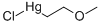
2-methoxyethylmercury chloride is an obsolete fungicide. Very little is known about its environmental fate. It is moderately toxic to birds and fish. It has a high oral mammalian toxicity, carcinogenic and is a reproduction/developmental toxin.
2-methoxyethylmercury chloride was commercially produced primarily through the oxymercuration reaction. In this process, mercuric chloride (or another mercuric salt) reacts with ethylene in methanol under controlled conditions, leading to the addition of mercury and methoxy group across the double bond to form the 2-methoxyethylmercury intermediate, which is isolated as the chloride salt. The reaction typically proceeds in the presence of a small amount of water or acid catalysis and yields the crude compound.
White powder with black granules.
Organometallics, such as METHOXYETHYL-MERCURY-CHLORIDE, are reactive with many other groups. Incompatible with acids and bases. Organometallics are good reducing agents and therefore incompatible with oxidizing agents. Often reactive with water to generate toxic or flammable gases. Organometallics containing halogens (fluorine, chlorine, bromine, iodine) bonded to the metal typically with generate gaseous hydrohalic acids (HF, HCl, HBr, HI) with water.
ACUTE/CHRONIC HAZARDS: METHOXYETHYL-MERCURY-CHLORIDE is toxic by ingestion. When heated to decomposition it emits highly toxic fumes.
Flash point data for METHOXYETHYL-MERCURY-CHLORIDE are not available. METHOXYETHYL-MERCURY-CHLORIDE is probably combustible.
Acts by reacting with the sulfydryl group in fungal pathogens and inhibits growth
Poison by ingestion and
subcutaneous routes. Experimental
reproductive effects. Human mutation data
reported. Used to control pineapple disease of sugarcane. When heated to
decomposition it emits very toxic fumes of
Hg and Cl-. See also MERCURY
COMPOUNDS and CHLORIDES.