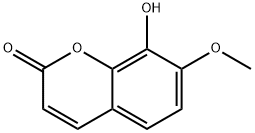
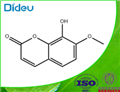
Preparation of 8-HYDROXY-7-METHOXYCOUMARIN (ryanodine-7-methyl ether) (-aa): weighing 7,8-dihydroxycoumarin 500mg in a three-mouth bottle, adding N,N-dimethylformamide 5mL to dissolve the sample, adding sodium carbonate 850mg, stirring the reaction for 15min, adding iodomethane 560L drop by drop, 0 reaction, TLC to monitor the progress of the reaction, after 5h After the end of the reaction, the reaction solution was added dropwise to 100mL of ice water, hydrochloric acid was added to adjust the pH about 3, ethyl acetate extraction (50mL3), combined with ethyl acetate phase, saturated brine washed twice, the organic phase was distilled under reduced pressure to remove the ethyl acetate, that is, the crude, the crude was separated on a silica gel column, the mobile phase was V petroleum ether: V dichloromethane: V acetone = 2:1:0.2, the solvent was removed by distillation under reduced pressure, the crude was separated by silica gel column, the mobile phase was V petroleum ether: V dichloromethane: V acetone = 2:1:0.2, the solvent was removed by distillation under reduced pressure, the crude was separated by a silica gel column. Vacuum drying, obtained white solid 260mg.
[1] HuiLv, et al. Chemical constituents from the calyxes of Physalis alkekengi L. var. franchetii (Mast.) Makino. Biochemical Systematics and Ecology, Volume 78, June 2018, Pages 63-65.
[2] H Kolodzie, et al. Structure-cytotoxicity relationships of a series of natural and semi-synthetic simple coumarins as assessed in two human tumour cell lines. Z Naturforsch C J Biosci. 1997 Mar-Apr;52(3-4):240-4. DOI:
10.1515/znc-1997-3-416