
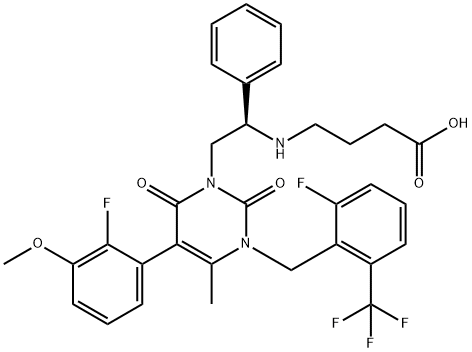
Chemical Properties
| Boiling point | 728.6±70.0 °C(Predicted) |
| Density | 1.350 |
| storage temp. | Store at -20°C |
| solubility | DMSO : ≥ 100 mg/mL (158.33 mM) |
| pka | 4.40±0.10(Predicted) |
| form | Solid |
| color | White to off-white |
| InChIKey | HEAUOKZIVMZVQL-VWLOTQADSA-N |
| SMILES | C(O)(=O)CCCN[C@H](C1=CC=CC=C1)CN1C(=O)N(CC2=C(C(F)(F)F)C=CC=C2F)C(C)=C(C2=CC=CC(OC)=C2F)C1=O |
Usage And Synthesis
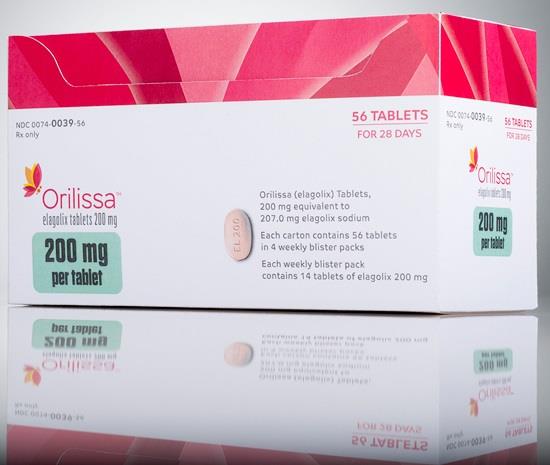
Side effects of elagolix include menopausal-like symptoms such as hot flashes, night sweats, insomnia, amenorrhea, mood changes, anxiety, and decreased bone density, among others. Elagolix is a GnRH antagonist, or an antagonist of the gonadotropin-releasing hormone receptor (GnRHR), the biological target of the hypothalamic hormone gonadotropin-releasing hormone (GnRH).[1] By blocking the GnRHR, it dose-dependently suppresses the gonadal production and hence circulating levels of sex hormones such as estradiol, progesterone, and testosterone. Elagolix is a short-acting GnRH antagonist, and can be used to achieve either partial or more substantial suppression of sex hormone levels. Reduced estrogen levels in the endometrium are responsible for the efficacy of elagolix in the treatment of endometriosis.
Elagolix acts as a potent and selective competitive antagonist of the gonadotropin-releasing hormone receptor (GnRHR), the biological target of the hypothalamic peptide hormone gonadotropin-releasing hormone (GnRH).As such, it is a GnRH antagonist.The affinity (KD) of elagolix for the GnRHR is 54 pM.By blocking the GnRHR in the pituitary gland, elagolix suppresses the GnRH-induced secretion of the gonadotropins luteinizing hormone (LH) and follicle-stimulating hormone (FSH) from the anterior pituitary, and thereby decreases the production of sex hormones by the gonads. In women, elagolix dose-dependently suppresses the production of ovarian hormones including estradiol, progesterone, and testosterone, and thereby decreases the circulating levels of these hormones.
In men, GnRH modulators suppress the testicular production of testosterone and estradiol, decreasing the circulating levels of these hormones similarly. Unlike previous GnRH agonists and antagonists, referred to collectively as GnRH analogues, elagolix is a non-peptide and small-molecule compound that can be taken orally. Estrogens like estradiol stimulate the growth of the endometrium, and thereby aggravate symptoms of endometriosis.By suppressing estrogen production and levels, elagolix decreases the growth of the endometrium and decreases endometriosis symptoms such as pelvic pain.
Elagolix is a short-acting GnRH antagonist, with a terminal half-life of typically about 4 to 6 hours.Because of the short duration of elagolix in the body, the activation of the GnRHR by GnRH is not fully blocked throughout the day with once-daily administration of elagolix. As a result, gonadotropin and sex hormone levels are only partially suppressed when elagolix is taken once per day.In addition, the degree of suppression can be dose-dependently adjusted as needed, for instance with higher-dose twice-daily administration to achieve greater hormonal suppression.Because of its short duration in the body, the effects of elagolix are rapidly reversible upon discontinuation. In addition, due to its partial and incomplete suppression of estradiol levels, the side effects of elagolix, such as hot flashes and decreased BMD, are lower than with first-generation GnRH modulators.
The side effects of elagolix are in general similar to menopausal symptoms.The most common side effects of elagolix (incidence ≥10%) are hot flashes, night sweats, headaches, nausea, and amenorrhea (cessation of menstruation). The next most frequent side effects of elagolix (incidence ≥5%) are insomnia, anxiety, arthralgia (joint pain), depression, and mood changes.Less common side effects of elagolix (incidence ≥3% and <5%) include decreased sex drive, diarrhea, abdominal pain, weight gain, dizziness, constipation, and irritability. Other common side effects of elagolix include decreased bone mineral density (BMD) and changes in the blood lipid profile. Rare but serious adverse effects that were observed during elagolix therapy in clinical trials included appendicitis (0.3%), abdominal pain (0.2%), and back pain (0.2%), though it is unknown if these were due to elagolix.Other serious adverse effects of elagolix may include bone loss, miscarriage, suicidality, and elevated liver enzymes.Elagolix was discontinued due to side effects by 5 to 10% of women in clinical trials, with the most common reasons being hot flashes or night sweats, nausea, and decreased BMD.
Elagolix dose- and duration-dependently decreases BMD in premenopausal women with long-term therapy. After 6 months of treatment with elagolix, lumbar spine BMD was decreased by 0.3 to 1.3% with 150 mg once per day and by 2.5 to 3.1% with 200 mg twice per day.The decrease in BMD during elagolix therapy may not be fully reversible with discontinuation, as only partial recovery was observed 12 months after discontinuation of therapy. The cause of the decrease in BMD with elagolix is estrogen deficiency, and is analogous to that associated with postmenopause.The consequences of the effects of elagolix on BMD are unknown, but may be an increase in the risk of bone loss and fractures.This is why the duration of use of elagolix should be limited. In women with risk factors for bone loss and osteoporosis, such as a history of low-trauma fracture, assessment of BMD may be considered. Elagolix should not be used in premenopausal women with known osteoporosis.Supplementation with calcium and/or vitamin D during treatment with elagolix has not been studied, but may be beneficial for helping to maintain bone health.
Contraindications of elagolix include pregnancy, known osteoporosis, severe hepatic impairment, and concomitant use with strong organic anion-transporting polypeptide (OATP) 1B1 inhibitors such as ciclosporin and gemfibrozil.Elagolix may increase the risk of miscarriage in early pregnancy.Women should avoid pregnancy while taking elagolix, for instance by using birth control, and should discontinue the medication if they become or wish to become pregnant. Elagolix should not be used in women with osteoporosis because it may increase the risk of further bone loss.
Severe hepatic impairment is associated with 7-fold increased exposure to elagolix, which may increase the risk of bone loss. In women with moderate hepatic impairment, which is associated with 3-fold increased exposure to elagolix, the medication at 200 mg twice per day should not be used, while 150 mg once per day should be used for no more than 6 months.OATP1B1 inhibitors are likely to greatly increase exposure to elagolix similarly to moderate to severe hepatic impairment.Combined birth control is not contraindicated with elagolix, but because of the estrogen component, is expected to decrease the effectiveness of elagolix in the treatment of endometriosis, and hence is not recommended.Other forms of birth control, such as non-hormonal birth control, can be used instead. Elagolix is not contraindicated in women who are breastfeeding, but it is unknown whether the medication is excreted in breast milk or if it has adverse effects on milk production or the breastfed child.The use of elagolix in women who are breastfeeding should be considered carefully, weighing both benefits and risks.
Elagolix results in dose-dependent suppression of luteinizing hormone(LH) and follicle-stimulating hormone(FSH) leading to decreased blood leveis of the ovarian sex hormones, estradiol and progesterone.Elagolix causes a dose-dependent decrease in bone mineral density (BMD).BMD loss is greater with increasing duration of use and may not be completely reversible after stopping treatment.
As milk production is dependent on at least minimal levels of estrogen, this product may reduce milk production.
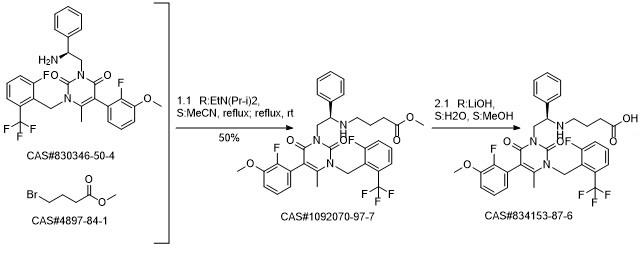
Recent Progress in the Synthesis of Elagolix
Discovery of sodium R-(+)-4-{2-[5-(2-fluoro-3-methoxyphenyl)-3-(2-fluoro-6-[trifluoromethyl]benzyl)-4-methyl-2,6-dioxo-3,6-dihydro-2H-pyrimidin-1-yl]-1-phenylethylamino}butyrate (elagolix), a potent and orally available nonpeptide antagonist of the human gonadotropin-releasing hormone receptor
Preparation Products And Raw materials
- 4-[[(1R)-2-[5-(2-fluoro-3-methoxyphenyl)-3-[[2-fluoro-6-(trifluoromethyl)phenyl]methyl]-3,6-dihydro-4-methyl-2,6-dioxo-1(2H)-pyrimidinyl]-1-phenylethyl]amino]-, ethyl ester3-[(2R)-2-Amino-2-phenylethyl]-5-(2-fluoro-3-methoxyphenyl)-1-[[2-fluoro-6-(trifluoromethyl)phenyl]methyl]-6-methyl-2,4(1H,3H)-pyrimidinedioneMethyl 4-bromobutyrate
elagolix manufacturers


Related articles
Which Diseases is Elagolix FDA-Approved For? May 14,2024
Related Product Information
- (R)-2-(Boc-aMino)-2-phenylethyl 4-Methylbenzenesulfonate
- 1-[(1R)-2-hydroxy-1-phenylethyl]pyrrolidin-2-one
- Carbamic acid, N-[(1R)-2-[5-(2-fluoro-3-methoxyphenyl)-3-[[2-fluoro-6-(trifluoromethyl)phenyl]methyl]-3,6-dihydro-4-methyl-2,6-dioxo-1(2H)-pyrimidinyl]-1-phenylethyl]-, 1,1-dimethylethyl ester
- Elagolix Sodium
- 1-[2-fluoro-6-(trifluoromethyl)benzyl]-5-iodo-6-methylpyrimidine-2,4(1H,3H)-dione
- Cetrorelix
- 5-(2-Fluoro-3-methoxyphenyl)-1-[[2-fluoro-6-(trifluoromethyl)phenyl]methyl]-6-methyl-2,4(1H,3H)-pyrimidinedione
- 3-[(2R)-2-Amino-2-phenylethyl]-5-(2-fluoro-3-methoxyphenyl)-1-[[2-fluoro-6-(trifluoromethyl)phenyl]methyl]-6-methyl-2,4(1H,3H)-pyrimidinedione
- 5-Bromo-1-(2-fluoro-6-trifluoromethyl-benzyl)-6-methyl-1H-pyrimidine-2,4-dione
- 2,2'-difluoro-3,3'-dimethoxy-1,1'-biphenyl
1of4
The What'sApp is temporarily not supported in mainland China