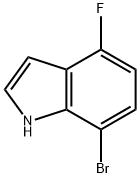
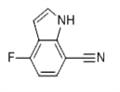
Step A: A mixture of 4-fluoro-7-bromoindole (600 mg, 2.8 mmol) with cuprous cyanide (CuCN, 1.004 g, 11.2 mmol) in N,N-dimethylformamide (DMF, 4 mL) was heated and refluxed for 16 hours. Upon completion of the reaction, the mixture was cooled to room temperature and subsequently poured into a methanol solution saturated with ammonia (30 mL) and filtered to remove insoluble residues. The filtrate was subsequently added to a mixture of water (20 mL) and saturated aqueous ammonia solution (20 mL) and extracted with ethyl acetate/ether (1:1, v/v) until thin-layer chromatography (TLC) analysis showed no product residue in the aqueous phase. The organic phases were combined, washed sequentially with saturated saline (2 x 200 mL) and water (200 mL), and dried over anhydrous magnesium sulfate (MgSO4). The organic phase was concentrated under reduced pressure to afford 4-fluoro-7-cyanoindole as a yellow-brown solid (310 mg, 69% yield).