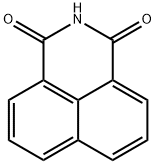
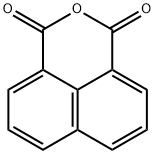
General method: A mixture of 1,8-naphthalenedicarboxylic anhydride (1 mmol), formamide (1.1 mmol for mono anhydride and 2.2 mmol for dianhydride) and 1 g of clay was placed in a mortar and thoroughly ground with a pestle and mortar for the time specified in Table 1. Subsequently, the reaction mixture was heated. Upon completion of the reaction (monitored by thin layer chromatography to confirm that no anhydride remained in the reaction mixture), the clay was washed with chloroform (2 x 15 mL) to extract the product. The solvent was removed under vacuum to give the corresponding N-unsubstituted cyclic imide. The solid imide was washed thoroughly with water, dried and recrystallized with ethanol. The solid clay portion was washed with methanol and dried under reduced pressure at 120 °C for reuse in subsequent reactions, but its activity decreases gradually (see Table 1). The products obtained from the isolation were characterized by determination of melting point, infrared spectroscopy (IR) and nuclear magnetic resonance hydrogen spectroscopy (1H NMR) data and verified by comparison with literature data or real samples.
[1] Journal of Organic Chemistry USSR (English Translation), 1987, vol. 23, # 5, p. 981 - 983
[2] Zhurnal Organicheskoi Khimii, 1987, vol. 23, # 5, p. 1086 - 1089
[3] Journal of the Chilean Chemical Society, 2017, vol. 62, # 2, p. 3501 - 3504
[4] Journal of Chemical Sciences, 2014, vol. 126, # 4, p. 1063 - 1074
[5] Synthetic Communications, 2001, vol. 31, # 12, p. 1927 - 1931