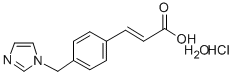
The main synthetic methods of ozagrel hydrochloride are as follows: 1) take p-toluylaldehyde as raw material, get methyl or ethyl p-toluyl cinnamate by Claisen condensation or by Knoevenagl reaction and then esterification, get alkyl p-bromomethyl cinnamate by bromination, get alkyl p-bromomethyl cinnamate by N-alkylation with imidazole or N-acyl imidazole under the action of strong alkaline and finally hydrolyze it to get ozagrel hydrochloride under alkaline heating condition or hydrolysis to get ozagrel hydrochloride by bromination first and then N-alkylation of p-toluylaldehyde. hydrolysis under alkaline heating conditions to obtain ozagrel hydrochloride, or p-methylbenzaldehyde is first brominated and then N-alkylated, and finally undergoes a Knoevenagl reaction to obtain ozagrel hydrochloride. The acid-binding agents used in this method, sodium hydride, 1-substituted imidazole, N-bromosuccinimide (NBS), are expensive, and there is also the possibility of using corrosive and toxic bromine, carbon tetrachloride, unfriendly to the environment, unsuitable for industrial production; p-carboxymethylbenzaldehyde as a raw material, through a multistep reaction to produce ozagrel hydrochloride, which has a long synthetic route, and needs to be separated by column chromatography, the operation of which is cumbersome and not suitable for industrial production of ozagrel hydrochloride. This method has a long synthetic route and requires column chromatographic separation, which is cumbersome and not suitable for the industrial production of ozagrel hydrochloride. (iii) Ozagrel hydrochloride was obtained by condensation, hydrolysis and acidification of mimosine and methyl 4-bromomethylcinnamate as raw materials under the condition of sodium hydride and N,N-dimethylformamide as solvent. In this synthetic route, the raw material methyl 4-bromomethylcinnamate is more expensive, and if prepared, it has to be re-esterified with p-methylcinnamic acid brominated with NBS, which is the more expensive brominated reagent. The use of sodium hydride and DMF both add to the cost, and sodium hydride is dangerous, and DMF is difficult to remove as a high boiling solvent.