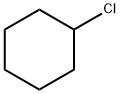
Take 158g of cyclohexane and add it to a four-necked flask equipped with a stirrer, a thermometer, a reflux condenser and a chlorine tube, add 0.1g of composite catalyst, place the four-necked flask in the dark, turn on the stirrer and rotate it at 100 rpm, heat it up to 60C, and pass the chlorine gas at a rate of 0.05l/min and maintain it for 10-20min; then reduce the temperature to 40C and increase the rate of chlorine gas passing to make 50g of chlorine gas within 4 hours. so that 50g of chlorine gas was passed in 4 hours. After the reaction material was neutralized with sodium carbonate and washed with water, it was first distilled at atmospheric pressure to obtain 101.5g of unreacted cyclohexane for the next synthesis, and then the 81-85 fraction was collected under the vacuum degree of 0.08MPa to obtain 68.2g of chlorinated cyclohexane, and the product was analyzed by gas chromatography of HP6890 with the content of 99.65%, the cyclohexane one-way conversion rate of 35.8%, the selectivity of 88.9%, the yield of 85.5% and the yield of 85.5%. The product was analyzed by HP6890 gas chromatography, the content was 99.65%, the one-way conversion of cyclohexane was 35.8%, the selectivity was 88.9% and the yield was 85.5%.
Wash chlorocyclohexane several times with dilute NaHCO3, then repeatedly with distilled water. Dry it with CaCl2 and fractionally distil it slowly at atmospheric pressure or better under vacuum. [Perlman et al. J Org Chem 1 294 1937, IR: Roberts & Chambers J Am Chem Soc 73 5031 1951, Beilstein 5 H 21, 5 I 8, 5 II 11, 5 III 37, 5 IV 48.]