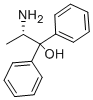
Reported synthetic methods fall into two categories: one involves the direct reaction of L-alanine, L-alanine hydrochloride, or L-alanine methyl ester with phenyl magnesium bromide to prepare (S)-2-amino-1,1-diphenyl-1-propanol. However, this method suffers from complex products, difficult purification, and low yields. The other method uses L-alanine as a starting material and involves a four-step reaction: methyl ester of L-2-benzylcarbonylaminoalanine, obtained through methylation and benzyloxycarbonyl protection, reacts with phenyl magnesium bromide to obtain (S)-benzyloxycarbonylamino-1,1-diphenyl-1-propanol, which is then catalytically hydrogenated to remove the benzyloxycarbonyl group, yielding (S)-2-amino-1,1-diphenyl-1-propanol. This paper reports a novel method for synthesizing (S)-2-amino-1,1-diphenyl-1-propanol.
In the presence of potassium carbonate and using water-ethanol as a mixed solvent, the amino and carboxyl groups of L-alanine molecule react simultaneously with benzyl chloride to generate N,N-dibenzyl-L-alanine benzyl ester (1); 1 reacts with magnesium phenyl bromide via a Grignard reaction to give 1,1-diphenyl-2-(N,N-dibenzylamino)-1-propanol (2); 2 is deprotected by Pd/C catalytic hydrogenation to obtain 3, with an overall yield of 48.1%. The intermediate and target products of this synthetic method are easily separated and purified. The synthetic reaction formula of (S)-2-amino-1,1-diphenyl-1-propanol is shown in the figure below: