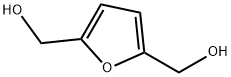
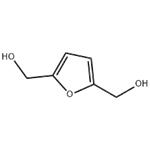
2,5-Furandimethanol is white or internally white solid in appearance, soluble in water, ethanol, acetone, pyridine, tetrahydrofuran, but insoluble in ethane, toluene, and dichloroethane.
It has the properties of dihydric alcohol. It can be esterified, alkoxylated, glycidyl etherification, cyanoethylation, etherification, urea alkylation, resination, etc.
1. Preparation of adsorbent:
Add 100Kg of ADS-17 medium polar adsorption resin, 5Kg of diethyl maleate, 0.5Kg of 2-methyl-4- (2,2,3-trimethyl-3-cyclopentene into the 2000L reactor -1-yl)-2-buten-1-ol, 700Kg water, 2Kg polyvinyl alcohol, 1Kg benzoyl peroxide, reacted at 80°C for 6h and then heated to 85°C for 2h, then heated to 95° C react for 6h, filter and dry to obtain adsorbent;
2 ·Adsorption purification of 2,5-furandimethanol:
Mix 100Kg of technical grade 2,5-furandimethanol and 1000Kg of deionized water at 90°C for 3 hours, and then pass through a chromatography column equipped with adsorbent for adsorption at a temperature of 90°C and a flow rate of 3BV/h. After dehydration, a purified product of 2,5-furandimethanol can be obtained.
5-(Hydroxymethyl)furfuryl alcohol is a heterocyclic organic compound that is naturally produced by certain wood-inhabiting fungi. It can be derived by the reduction of the formyl group of 5-hydroxymethylfurfural. 5-(Hydroxymethyl)furfuryl alcohol can be used as a building block in the enzymatic synthesis of biobased polyesters.
Off-White to Pale Yellow Solid
5-(Hydroxymethyl)furfuryl Alcohol is a secondary metabolite of Xylaramide, a new antifungal compound.
ChEBI: A furan carrying two hydroxymethyl substituents at the 2- and 5-positions.
5-(Hydroxymethyl)furfuryl alcohol is a heterocyclic organic compound that is naturally produced by certain wood-inhabiting fungi. It can be derived by the reduction of the formyl group of 5-hydroxymethylfurfural. 5-(Hydroxymethyl)furfuryl alcohol can be used as a building block in the enzymatic synthesis of biobased polyesters.
[1] G SCHNEIDER O S H Anke. Xylaramide, a new antifungal compound, and other secondary metabolites from Xylaria longipes.[J]. Zeitschrift Fur Naturforschung Section C-A Journal of Biosciences, 1996, 51 11-12: 802-806. DOI:
10.1515/znc-1996-11-1206[2] Z L LIU. Adaptive response of yeasts to furfural and 5-hydroxymethylfurfural and new chemical evidence for HMF conversion to 2,5-bis-hydroxymethylfuran.[J]. Journal of Industrial Microbiology & Biotechnology, 2004, 31 8: 345-352. DOI:
10.1007/s10295-004-0148-3[3] YAN ZHANG Thaddeus C E Bei Han. Biotransformation of furfural and 5-hydroxymethyl furfural (HMF) by Clostridium acetobutylicum ATCC 824 during butanol fermentation[J]. New biotechnology, 2012, 29 3: Pages 345-351. DOI:
10.1016/j.nbt.2011.09.001[4] YI JIANG. Enzymatic Synthesis of Biobased Polyesters Using 2,5-Bis(hydroxymethyl)furan as the Building Block[J]. Biomacromolecules, 2014, 15 7: 2482-2493. DOI:
10.1021/bm500340w