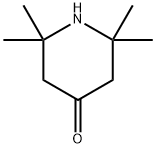
Triacetonamine has anti-arrhythmic and anti-myocardial ischemia effect.
Take Triacetonamine as raw materials, ethanol as the solvent, perform hydrogenation reaction in the presence of catalyst (normal pressure or 3~4MPa) and obtain raw material of histamine-type light stabilizer 2,2,6,6-tetramethyl-4-piperidinol.
.
It appears as white or light yellow powder with the melting point being 43 ℃ and boiling point being 205 ℃. It is soluble in acetone, alcohol, ether and water.
The above information is edited by the chemicalbook of Dai Xiongfeng.
The product is the intermediate and pharmaceutical intermediate of histamine light stabilizer. Itself also has light-stabilizing effect. It has important application in pharmaceuticals.
Triacetonamine (CAS 826-36-8), also known as 2,2,6,6-tetramethyl-4-piperidone or TAA, is a key intermediate in the synthesis of HALS (hindered amine light stabilisers); Their ability to effectively inhibit polymer degradation by scavenging free radicals is based on their sterically hindered amine functional groups, which are capable of forming stable N-oxides as active intermediates (the Denysov cycle). TAA is also used in the synthesis of pharmaceuticals, piperidine nitroso radicals and pyrrolidone derivatives. For example, the oxidation of TAA or its derivatives yields the corresponding tetramethylpiperidine-N-oxide, namely TEMPO; the latter can be used as a polymerisation inhibitor, molecular weight regulator or oxidation catalyst[2].
2,2,6,6-Tetramethyl-4-piperidinone (cas# 826-36-8) is a compound useful in organic synthesis.
ChEBI: Triacetonamine is a member of piperidones.
The routes of triacetonamine synthesis includes[1]:
a. From acetone and ammonia. Triacetonamine was initially prepared by the method of Francisfrom acetone and ammonia in the presence of an acidic catalyst like calcium chloride in a 20% yield. Co-catalysts bromine or iodine combined with acid halides of the type XCH2COX acted as synergists.
b. From phorone and ammonia. Phorone reacted with ammonia to give triacetonamine via the nucleophilic addition of nitrogen to the olefi nic bond.
c. From N-oxides. Triacetonamine was formed via reduction of cation in the presence of NaOH in acetone media.
d. From alcohols. Photogenerated singlet oxygen was used in oxidation of alcohol with formation of triacetonamine under mild and facile conditions using the catalyst CoIIDPDME.
e. From dimethylamine derivatives. Dimethylamine was alkylated by methyl iodide. The following hydrolysis gave triacetonamine.
Triacetonamine (Purchased from MCE; 200 mg, 300 mg, 400 mg/Kg/day; gavage; 2 days) shows typical hepatoenteropathology of ALF with 300 mg/Kg/day and 400 mg/Kg/day, while the group of 400 mg/Kg/day had higher mortality[2].
| Animal Model: | Rats (half male and female, 6-8 weeks old, 200±10 g)[2] |
| Dosage: | 200 mg, 300 mg, 400 mg/Kg |
| Administration: | Gavage; daily; 2 days |
| Result: | Showed typical hepatoenteropathology of ALF with 300 mg/Kg/day and 400 mg/Kg/day, while the group of 400 mg/Kg/day had higher mortality.
|
[1] Yousif, M. N. M., Soliman, H. A., Said, M. M., Hassan, N. A., & Abdel-Megeid, F. M. E. (2020). Synthesis and Biological Activity of Triacetonamine. Russian Journal of General Chemistry, 90 3, 460–469.
https://doi.org/10.1134/S1070363220030202[2] Gherardo Gliozzi . (2014). Towards a more sustainable production of triacetoneamine with heterogeneous catalysis. Journal of Molecular Catalysis A: Chemical, 393, Pages 325-332.
https://doi.org/10.1016/j.molcata.2014.06.023