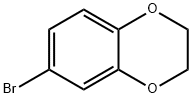
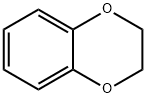
6-Bromo-1,4-benzodioxane is an aryl halide. It can be synthesized from 1,4-benzodioxane, via bromination with bromine in acetic acid. It undergoes alkoxycarbonylation reaction with sodium tert-butoxide in the presence of CO to yield 2,3-dihydro-benzo[1,4]dioxine-6-carboxylic acid t-butyl ester.
General procedure for the synthesis of 6-bromo-1,4-benzodioxane from 1,4-benzodioxane: 35 g of 1,4-benzodioxane and 200 ml of anhydrous dimethylformamide were added to a reaction flask and cooled to 0 °C under argon protection. Subsequently, 54.9 g of N-bromosuccinimide was added in batches. After the reaction mixture was gradually warmed up to room temperature, stirring was continued for 24 hours. After completion of the reaction, the solvent was removed by distillation under reduced pressure and the white solid obtained was washed with dichloromethane. The filtrates were combined and treated with 50 ml of saturated aqueous sodium sulfate solution, washed with 50 ml of saturated aqueous sodium chloride solution and finally dried with anhydrous magnesium sulfate. After evaporation of the solvent under reduced pressure, a yellow oily product was obtained (quantitative yield). The product was confirmed by EI mass spectrometry with molecular ion peak M+ = 214. 1H NMR (200 MHz, CDCl3) data were as follows: δ 4.25 (4H, s); 6.74 (1H, d); 6.93 (1H, dd); 7.02 (1H, d).
[1] Tetrahedron Letters, 2003, vol. 44, # 4, p. 823 - 826
[2] European Journal of Organic Chemistry, 2003, # 10, p. 1931 - 1941
[3] Patent: US2004/260101, 2004, A1. Location in patent: Page 5-6
[4] Organic Process Research and Development, 2003, vol. 7, # 3, p. 399 - 406
[5] Synthetic Communications, 2008, vol. 38, # 16, p. 2814 - 2819