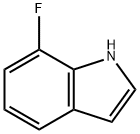
7-Fluoroindole is a reagent used in chemical synthesis. It has been used to synthesize antiviral compounds against Pseudomonas aeruginosa and Staphylococcus aureus along with creation of immunomodulators. It is an important raw material and intermediate used in organic synthesis, pharmaceuticals, agrochemicals and dyestuffs.
7-fluoroindole (7FI) was identified as a compound that inhibits biofilm formation and blood hemolysis without inhibiting the growth of planktonic P. aeruginosa cells. Moreover, 7FI markedly reduced the production of quorum-sensing (QS)-regulated virulence factors 2-heptyl-3-hydroxy-4(1H)-quinolone, pyocyanin, rhamnolipid, two siderophores, pyoverdine and pyochelin. 7FI clearly suppressed swarming motility, protease activity and the production of a polymeric matrix in P. aeruginosa. However, unlike natural indole compounds, synthetic 7FI did not increase antibiotic resistance. Therefore, 7FI is a potential candidate for use in an antivirulence approach against persistent P. aeruginosa infection.
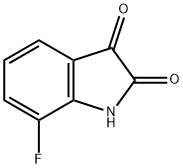
Under nitrogen protection, 4 g (0.024 mol) of 7-fluoroindigo red and 3.52 g (0.093 mol) of sodium borohydride were placed in a dry four-necked flask and cooled below -10 °C. Under stirring conditions, 40 mL of anhydrous tetrahydrofuran and 7.6 g (0.054 mol) of boron trifluoride ether compounds were slowly added dropwise, keeping the temperature at no more than -5 °C throughout the dropwise addition. The reaction mixture was stirred at room temperature overnight. Upon completion of the reaction, a solution prepared from 6.6 g of sodium bisulfate and 70 mL of water was slowly added dropwise to the reaction mixture. Subsequently, the mixture was steam distilled and the distillate was extracted with ethyl acetate. The extract was dried over anhydrous magnesium sulfate and the solvent was removed by distillation to give 2.58 g of white acicular 7-fluoroindole in 78.8% yield.