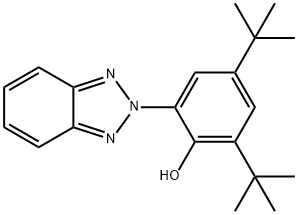
UV-320 is a benzotriazole UV stabilizer, which is used to increase product stability and to prevent discolouration in various consumer and industrial goods such as plastics. Benzotriazole UV stabilizers are a pollutant for the aquatic environment and have been implicated as a potential stable and toxic ligands for aryl hydrocarbon receptor in human.
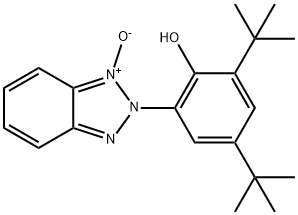
The general procedure for the synthesis of 2-(2H-3,5-di-tert-butyl-2-hydroxyphenyl)benzotriazole from 2-(2'-hydroxy-3',5'-di-tert-butylphenyl)benzotriazole N-oxide is as follows:
Example 3: 10 g (0.03 mol) of 2-(2'-hydroxy-3',5'-di-tert-butylphenyl)benzotriazole-N-oxide, 100 mg of palladium-carbon catalyst, 100 ml of solvent mixture of toluene and water (4:1 ratio by volume), and 3 g of 50% dimethylamine solution were added to a 500 ml autoclave equipped with a stirrer. After replacing the air in the autoclave with hydrogen, the hydrogen pressure was set to 10 kg/cm2. The temperature was raised to 50 °C with stirring, and the reaction was maintained at this temperature until no more hydrogen was absorbed by the mixture. After completion of the reaction, the autoclave was cooled and the catalyst was removed by filtration. A portion of the filtrate was quantitatively analyzed by GC and the yield of 2-(2'-hydroxy-3',5'-di-tert-butylphenyl)benzotriazole was measured to be 85.6%. After removing the solvent from the filtrate by distillation, the residual solid was crystallized with ethanol and subsequently washed with ethanol to give 7.1 g of 2-(2'-hydroxy-3',5'-di-tert-butylphenyl)benzotriazole (71% yield; melting point 152-155 °C).
[1] Tetrahedron Letters, 1997, vol. 38, # 48, p. 8303 - 8306
[2] Tetrahedron Letters, 1997, vol. 38, # 5, p. 845 - 848
[3] Journal of Organic Chemistry, 1995, vol. 60, p. 5683 - 5685
[4] Australian Journal of Chemistry, 1982, vol. 35, # 10, p. 2089 - 2093
[5] Patent: US5104992, 1992, A