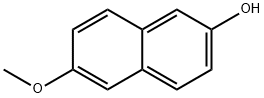
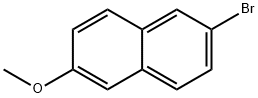
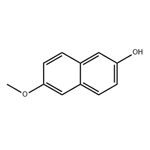
The general procedure for the synthesis of 6-methoxy-2-naphthol from 2-bromo-6-methoxynaphthalene was as follows: activated magnesium scrapings (7.5 mmol, 1.5 eq.) and 5 mL of anhydrous tetrahydrofuran (THF) were added to a flame-dried 25 mL round-bottom flask. Two drops of 1,2-dibromoethane were added to the suspension to initiate the reaction.After 5 min, a solution of 2-bromo-6-methoxynaphthalene (5 mmol, 1.0 eq.) dissolved in 5 mL of anhydrous THF was slowly added dropwise to the magnesium suspension at room temperature. A mild exothermic phenomenon was observed during the reaction. After confirming the formation of Grignard's reagent by titration, 1 mmol of this Grignard's reagent was taken and transferred to another flame-dried reaction flask. This solution was diluted with 3 mL of anhydrous THF and cooled to 0 °C in an ice-water bath before slowly adding a solution of oxaziridine (1.5 mmol, 1.5 equiv) dissolved in 1 mL of anhydrous THF. The ice water bath was removed and the reaction mixture was allowed to gradually warm up to room temperature. After the reaction was carried out for t time, the reaction was quenched with saturated aqueous ammonium chloride (NH4Cl) solution. The reaction mixture was diluted with 20 mL of saturated sodium chloride (NaCl) aqueous solution and 20 mL of ethyl acetate (EtOAc). The organic layer was separated and the aqueous layer was subjected to a secondary extraction with ethyl acetate (2 x 20 mL). All organic layers were combined, dried with anhydrous sodium sulfate (Na2SO4), filtered and concentrated under reduced pressure. Finally, the residue was purified by fast column chromatography to obtain the target product 6-methoxy-2-naphthol.
[1] Synthesis, 2010, # 24, p. 4268 - 4272
[2] Nature Chemistry, 2017, vol. 9, # 7, p. 681 - 688
[3] Patent: US2018/57444, 2018, A1. Location in patent: Paragraph 0098; 0226; 0228
[4] Patent: CN104876912, 2017, B. Location in patent: Paragraph 0047; 0175-0178
[5] Organic and Biomolecular Chemistry, 2016, vol. 14, # 24, p. 5751 - 5754