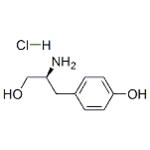
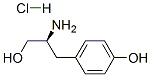
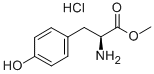
General procedure for the synthesis of L-tyrosinol hydrochloride and compounds (CAS:10125-12-9) from L-tyrosine methyl ester hydrochloride: the reaction was carried out in a 0.5 L stainless steel autoclave with stirring at 500 rpm to assess the activity of the catalyst for the hydrogenation of R-phenylglycine methyl ester. First, 1 g of catalyst (20-40 mesh) was loaded into the reactor and subsequently purged five times with H2 to remove air. The catalyst was reduced at 1 MPa H2 pressure and 250 °C for 4 hours. After the autoclave was cooled to room temperature in H2 atmosphere, 1.5 g of R-phenylglycine methyl ester (R-p-m) diluted by 150 mL of ethanol (R-p-m/Cat = 1.5, w/w) was added. The standard reaction conditions were set at 5 MPa H2 pressure and 80 °C temperature for 10 h. The reaction was carried out in an autoclave. Upon completion of the reaction, the autoclave was cooled to room temperature in H2 atmosphere. Subsequently, the solid catalyst was separated by centrifugation. The product was purified by silica gel column chromatography using ethyl acetate/methanol (3/2, v/v) as eluent. Finally, the light yellow powdery product was obtained by rotary evaporation. The analysis of the reactants and products was carried out using a high performance liquid chromatograph (HPLC, Agilent 1260 Infinity) equipped with a UV detector and an Eclipse XDB-C18 column (150 × 4.6 mm, 5 μm particles), which in turn was used to calculate the conversion of R-phenylglycine methyl ester (X), yield (Y), and chemoselectivity for R-phenylglycine (S), where yield is the liquid chromatographic yield. The enantiomeric excess values (ee values) of the products were determined by HPLC equipped with a UV detector (wavelength 258 nm) and a chiral column (CHIRALPAK AY-H, 250 × 4.6 mm, 5 μm particle size).

![2,5-Piperazinedione, 3,6-bis[(4-hydroxyphenyl)methyl]-, (3R,6S)-rel-](/CAS/20210305/GIF/10125-12-9.gif)