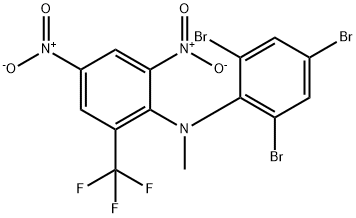
Bromethalin is an unclassified rodenticide. It has a low aqueous solubility and is not considered volatile. It may be persistent in soil systems but, based on its physico-chemical properties, it is not expected to leach to groundwater. It is highly toxic to most fauna although data is a little scant. Bromethalin is also highly toxic to mammals via the oral route.
Pale yellow, water-insoluble crystalline
substance.
Bromethalin is used to control rats and mice indoors and outdoors.
It is more effective against rats.
ChEBI: Bromethalin is a C-nitro compound.
Bromethalin is synthesised through a multi-step chemical process starting with the formation of 2,4-dinitro-N-phenyl-6-(trifluoromethyl)aniline via a coupling reaction. This intermediate undergoes methylation to produce N-methyl-2,4-dinitro-N-phenyl-6-(trifluoromethyl)aniline, which is then subjected to a bromination reaction using 2,4-dibromobenzene to yield N-methyl-2,4-dinitro-N-(2,4-dibromophenyl)-6-(trifluoromethyl)aniline. A final secondary bromination step completes the synthesis of bromethalin.
Poisonous; moderately toxic; causes
headache, confusion, personality changes, seizures,
coma, death.
Toxin attacking central nervous system. Inhibitor of mitochondrial ATP synthase.
Bromethalin is a complex molecule possessing several functional groups
and rapid and multi-pathway metabolism would be expected. There is a
dearth of information published on its environmental fate and metabolism
in plants but some limited information on metabolism in rats is
available.
Bromethalin is produced by reaction of 2,4-dinitro-6-
trifluoromethyl methylaniline with 1,2,3,5-tetrabromobenzene
(15).
This compound has been known for some time to have
rodenticidal properties (16) but has only recently been
made available. Bromethalin is used in baits at a concentration
of 0.005 or 0.01% and is effective against rodents
resistant to anticoagulants. It does not induce bait shyness.
Anorexia occurs after an effective dose has been consumed.
The mode of action is by uncoupling oxidative phosphorylation
in cells of the central nervous system. Symptoms
of poisoning include tremors, convulsions, prostration, and
hind-limb paralysis. No specific antidote is available but a
symptomatic treatment has been described (17).
Trade Names. Assault (Purina Mills), Vengeance (Dow-
Elanco).
The following acute and subacute compounds are used
for rodent control less frequently than those listed above,
either because they are not widely available or because
restrictions have been placed upon their use due to safety
considerations (11,18).
Bromethalin is stable under normal storage conditions but it is degraded
by UV light.