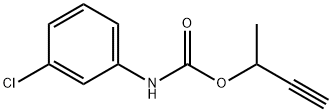
Chlorbufam is a carbamate herbicide which is considered to be obsolete. It is moderately soluble in water and in many organic solvents. It has a low volatility and, based on its chemical properties, it has a high potential for leaching to groundwater. It is moderately persistent in soil systems. It has a low mammalian oral toxicity and its a recognised irritant. There are significant data gaps regarding ecotoxicity.
Chlorbufam is a pesticide.
ChEBI: Chlorbufam is a carbamate ester.
The commercial production of chlorbufam involves synthesising its core structure through carbamate formation. The process typically starts with the reaction of 3-chlorophenylamine with methylpropargyl chloroformate or a similar reactive intermediate to form the N-(3-chlorophenyl)carbamate backbone. This step is carried out under controlled conditions to ensure proper substitution and minimize side reactions. The resulting compound is then purified, often via distillation or crystallisation, to achieve the desired technical grade. Final formulation involves blending the active ingredient with suitable carriers and surfactants to create a stable product for agricultural application.
Inhibits photosynthesis. Cell division inhibitor.