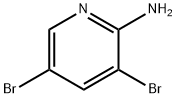
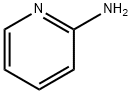
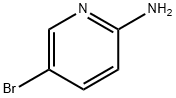
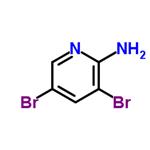
General procedure for the synthesis of 2-amino-5-bromopyridine and 2-amino-3,5-dibromopyridine from 2-aminopyridine: 28.2 g (0.3 mol) of 2-aminopyridine was dissolved in 50 ml of acetic acid. The solution is cooled to below 20°C by means of an ice bath and 48 g (15.4 ml, 0.3 mol) of bromine dissolved in 30 ml of acetic acid is added slowly and dropwise over a period of 1 h under vigorous stirring. The temperature was maintained below 20°C at the beginning of the reaction. Upon addition of half of the bromine solution, the reaction temperature was raised to 50°C to promote precipitation of 2-amino-5-bromopyridine hydrobromide. At 50°C, the hydrobromide typically begins to crystallize when about three-quarters of the bromine is added. After completion of the bromine addition, stirring of the reaction mixture was continued for 1 hour, followed by dilution with 75 mL of water to dissolve the hydrobromide. The reaction solution is transferred to a 500 ml beaker and neutralized by the slow addition of 120 ml of 40% sodium hydroxide solution under stirring and cooling conditions. Filtration and drying gave a crude product of 2-amino-5-bromopyridine containing a small amount of 2-amino-3,5-dibromopyridine. The 2-amino-3,5-dibromopyridine was removed from the crude product by washing with 500 ml of hot petroleum ether in three passes. The final yield of 2-amino-5-bromopyridine was 32-34.7 g (62-67% yield) with a melting point of 134°C (literature value: 132-135°C).
Steam distil it and recrystallise it from aqueous EtOH or pet ether. [Beilstein 22 H 431, 22 II 333, 22 III/IV 4041.]
[1] Synthetic Communications, 1986, vol. 16, # 13, p. 1641 - 1646
[2] Canadian Journal of Chemistry, 2005, vol. 83, # 2, p. 146 - 149
[3] Synthesis (Germany), 2015, vol. 47, # 20, p. 3169 - 3178
[4] Journal of Organic Chemistry, 1983, vol. 48, # 7, p. 1064 - 1069
[5] Bioorganic and Medicinal Chemistry, 2012, vol. 20, # 7, p. 2455 - 2478