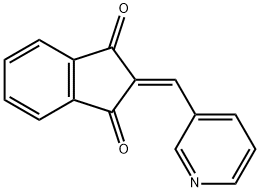
PRT-4165 (31083-55-3) is an inhibitor of Bmi1/Ring1A, subunits of the polycomb repressive complex 1 (PRC1). Inhibits self-ubiquitination (IC50= 3.9 μM) but does not increase cellular levels of either subunit. Blocks Bmi1/Ring1A-mediated ubiquitination and drug-induced degradation of topoisomerase 2α.1PRT-4165 inhibits H2A/H2AX ubiquitination via blocking the E3 ubiquitin ligase activity of RNF2 and a Bmi1/RNF2 complex. Blocks polycomb repressor complex (PRC) 1-mediated histone H2A ubiquitinationin vitroandin vivoand as such represents a new tool for studying chromatin remodeling.2
PRT4165 is a potent inhibitor of polycomb-repressive complex 1 (PRC1)-mediated H2A ubiquitylation.
PRT4165 is a potent inhibitor of PRC1 (polycomb-repressive complex 1)-mediated histone H2A ubiquitylation in vivo and in vitro. PRT4165 inhibits the in vitro histone H2A E3 ubiquitin ligase activity of PRC1 components RING1, RNF2, and a BMI1/RNF2 complex. PRT4165 also inhibits DNA double-strand breaks induced ubiquitylation of histone H2AX.
The small-molecule PRT-4165 inhibits the E3 ligase activity of Bmi1/Ring1A, inhibits ubiquitination of topoisomerase Top2α, and alters Bmi1 localization from nucleolar bodies to more disperse nuclear and cytoplasmic localizations. PRT-4165 inhibits both Ring1A and RNF2, which account for the polycomb-repressive complex 1 E3 ubiquitin ligase activity. PRC1-mediated ubiquitylation of histones plays an important role in DNA repair and gene silencing, and may be relevant in determining cell fate and development of human cancers. Treatment of cells with PRT-4165 inhibited H2A ubiquitylation in cells and at sites of DNA damage, resulting in delayed double-strand break repair and impaired response to genotoxic stress. PRT-4165 treatment of leukemia cells suppressed cell growth and downregulated NOTCH signaling protein expression. PRT-4165 treatment of differentiating human embryonic stem cells promoted neuroectodermal differentiation, indicating that Ring1B regulation could be used to direct stem cells toward an early neuronal fate.
[1] IRIS ALCHANATI. The E3 ubiquitin-ligase Bmi1/Ring1A controls the proteasomal degradation of Top2alpha cleavage complex - a potentially new drug target.[J]. PLoS ONE, 2009, 4 12: e8104. DOI:
10.1371/journal.pone.0008104[2] ISMAIL HASSAN ISMAIL. A small molecule inhibitor of polycomb repressive complex 1 inhibits ubiquitin signaling at DNA double-strand breaks.[J]. The Journal of Biological Chemistry, 2013, 288 37: 26944-26954. DOI:
10.1074/jbc.m113.461699