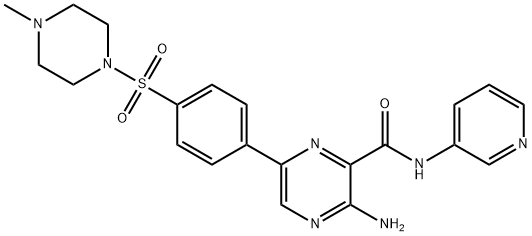
AZD2858 is a selective GSK-3 inhibitor with an IC50 of 68 nM, activating Wnt signaling, increases bone mass in rats.
AZD2858 is a selective GSK-3 inhibitor with an IC50 of 68 nM, inhibits tau phosphorylation at the S396 site, activates Wnt signaling pathway. AZD2858 treatment (1 μM, 12 h) on primary isolated human osteoblast-like cells results in a 3-fold increase of β-catenin levels. AZD2858 causes β-catenin stabilisation in human and rat mesenchymal stem cells, stimulates hADSC commitment towards osteoblasts and osteogenic mineralisation in vitro.
In rats, oral AZD2858 treatment causes a dose-dependent increase in trabecular bone mass compared to control after a two-week treatment with a maximum effect at a dose of 20 mg/kg once daily (total BMC: 172% of control). A small but significant effect is also seen at cortical sites (total BMC: 111% of control). AZD285 treatment (30 μmol/kg) on rats daily for up to 3 weeks shows an increase in both mineral density (of 28% at 2 weeks and 38% at 3 weeks) and mineral content (of 81% at 2 weeks and 93% at 3 weeks) in the calluses. AZD285 treatment makes the fractures heals more rapidly, with a bony callus without an obvious endochondral component. AZD2858 produces time-dependent changes in serum bone turnover biomarkers and increases bone mass over 28 days exposure in rats. After 7 days, AZD2858 increases the bone formation biomarker P1NP, and reduces the resorption biomarker TRAcP-5b, indicating increased bone anabolism and reduced resorption in rats.
AZD 2858 is a highly selective glycogen synthase kinase-3β (GSK3β) inhibitor used in the treatment of neurological diseases such as Alzheimer’s (1).
ChEBI: AZD2858 is a member of the class of pyrazines that is pyrazine substituted by (pyridin-3-yl)aminocarbonyl, amino, and 4-(4-methylpiperazine-1-sulfonyl)phenyl groups at positions 2, 3 and 6, respectively. It is a potent inhibitor of GSK3alpha and GSK3beta (IC50 values of 0.9 and 4.9 nM, respectively) and increases bone mass (via Wnt activation) in rats. It has a role as an EC 2.7.11.26 (tau-protein kinase) inhibitor, an antineoplastic agent, a bone density conservation agent and a Wnt signalling activator. It is a member of pyrazines, a secondary carboxamide, a member of pyridines, a N-methylpiperazine, a sulfonamide and an aromatic amine.
AZD2858 (20 mg/kg) causes a dose-dependent increase in trabecular bone mass compared to control after a two-week treatment with a maximum effect[1]. AZD2858 exhibits a substantial effect on fracture healing. AZD2858 (20 mg/kg) causes an increase in cortical BMC of 9%, cortical area of 10%, and cortical thickness of 11% at 3 weeks in the non-operated right femur of rats[2]. AZD2858 (30 μmol/kg/day) alters the biomarkers of bone turnover with statistically significant increases in P1NP and decreases in TRAcP-5b seen from 3 days of treatment and onwards. AZD2858 demonstrates significant changes in serum bone turnover markers (P1NP and TRAcP-5b) and femur bone formation after only 7 days of daily dosing[3]. AZD2858 (AR28, 30 mg/kg, s.c.) stimulates an increase in an initial wave of mesenchymal progenitors with osteogenic and adipogenic potential and drives their differentiation to the osteogenic lineage in BALB/c mice. AR28 (30 mg/kg, s.c.) enhances the proliferation of committed hematopoietic progenitors and their differentiation to the osteoclast lineage but does not prevent an overall increase in bone mass[4].
GSK-3α: 0.9 nM (IC50); GSK-3β: 5 nM (IC50); CDK5/p25: 356 nM (IC50); Haspin: 366 nM (IC50); CDK5/p35: 387 nM (IC50); DYRK2: 491 nM (IC50); CDK2/cyclin A: 810 nM (IC50); CDK1/cyclin B: 1246 nM (IC50); PIM3: 1269 nM (IC50); TLK2: 1381 nM (IC50); PKD2: 2462 nM (IC50); CDK2/cyclin E: 3310 nM (IC50); Aurora-A: 4966 nM (IC50)