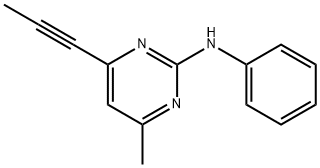
Light yellow crystalline powder, melting point 125~126℃, vapor pressure 1.33mPa at 20℃, solubility 5.58mg/L in water at 20℃, soluble in most organic solvents. kow2600. stable at pH4~θ. Toxicity: Acute oral LD50>5000mg/kg for rat and mouse, acute percutaneous LD50>2000mg/kg for rat, no irritation to rabbit's skin and eyes, no sensitization to guinea pig's skin, no mutagenicity in Ames test. Acute oral LD50>2250mg/kg in quail and duck, LC50 >3.8mg/L in bluegill, LC503.1mg/L in rainbow trout.
Mepanipyrim is an anilinopyrimidine fungicide which have been used in the management of fungal diseases in strawberries.
Mepanipyrim is a non-systemic fungicide that provides preventative
control of diseases in pome fruits (scab), vines, strawberries, tomatoes
and cucumbers (grey mould) and peaches (brown rots) caused by Botrytis
cinerea, Venturia inaequaris and Monilinia fructicola.
ChEBI: A member of the class of aminopyrimidines that is N-phenylpyrimidin-2-amine carrying additional methyl and 1-propynyl substituents at positions 4 and 6 respectively. A fungicide used to control a wide range of diseases including grey mou
d on strawberries, tomatoes and cucumabers, and scab on apples and pears.
The industrial production of mepanipyrim begins with the synthesis of a substituted pyrimidine core, typically derived from 2-amino-4,6-dimethylpyrimidine. This intermediate undergoes acylation with 4-methylbenzoyl chloride to form a key amide linkage. The reaction is carried out under controlled conditions using organic solvents like dichloromethane and a base such as triethylamine to neutralize by-products and drive the reaction to completion. The resulting compound, mepanipyrim, is then purified through crystallisation or solvent extraction to ensure high chemical purity.
Non-systemic with preventative action. Inhibits protein synthesis.
By tomato seedlings, 14C-mepanipyrim is
biotransformed via the pathways including elimination
of the phenyl group, hydroxylation of the propynyl
moiety, and hydroxylation at the phenyl ring to yield
several kinds of metabolite, and 2- and 4-[4-methyl-6-
(1-propynyl)pyrimidin-2-ylamino]phenols, 1-(2-anilino-6-
methylpyrimidin-4-yl)-2-propanol, and 4-methyl-6-(1-
propynyl)pyrimidin-2-ylamine are tentatively identified
as major metabolites. In soils under laboratory
conditions, 14C-mepanipyrim undergoes degradation to
give the degradation products and the main pathway
is elimination of the phenyl group.
Mepanipyrim (1) is stable to hydrolytic degradation in the pH range
4-9 with a DT50 >1 year. It decomposed rapidly in water when exposed
to light (DT50 13 days) (PM).
Fungicide; Other susbtance