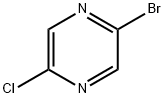
2-Bromo-5-chloropyrazine is an intermediate of favipiravir. Favipiravir is a selective inhibitor of the RNA-dependent RNA polymerase of influenza viruses. This drug is a broad-spectrum antiviral agent. It is indicated for the treatment of seasonal influenza, H1N1, Ebola and other diseases.
2-Bromo-5-chloropyrazine is synthesised by first reacting dibromoheine with 2-aminopyrazine to yield 2-amino-5-bromopyrazine. The 2-amino-5-bromopyrazine is then dissolved in DCM, and titanium(IV) chloride and tert-butyl nitrite are added to complete the reaction. The reaction process consists of two steps, as follows:
Step 1: Formation of 2-amino-5-bromopyrazine
Under stirring conditions in an ice-salt bath and a nitrogen atmosphere, an acetonitrile solution of dibromoheine was added dropwise to an acetonitrile solution of 2-aminopyrazine. Upon completion of the addition, the mixture was stirred at 0–5 °C. Thin-layer chromatography confirmed the absence of 2-aminopyrazine in the reaction system, The reaction is complete; the reaction is then quenched. The reaction mixture is concentrated to remove acetonitrile, followed by extraction. The organic phase is collected, the solvent is removed, and the organic phase is dried. Recrystallisation is then carried out to yield 2-amino-5-bromopyrazine;
Step 2: Preparation of 2-bromo-5-chloropyrazine
Dissolve the 2-amino-5-bromopyrazine obtained in Step (1) in DCM, then add titanium(IV) chloride and stir to mix at 0 °C. Subsequently, add tert-butyl nitrite dropwise to the reaction mixture, stir for 20–30 minutes, then raise the temperature to room temperature and continue stirring for 8–12 hours. Upon completion of the reaction, quench the reaction. Allow the reaction mixture to stand until separation occurs, then separate the organic phase. Extract the aqueous phase with dichloromethane. Combine the organic phases, wash with saturated brine and dry. Purify the dried organic phase by removing the solvent to afford the target product, 2-bromo-5-chloropyrazine.