2) Example 1-2: Preparation of ethyl acetimidate hydrochloride
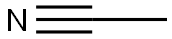
1.6 kg of acetonitrile and 4.3 kg of ethanol were added to the reactor and the reactor was cooled to -10°C. 3.67 kg of acetyl chloride was slowly added under stirring and the reaction mixture was kept stirred at 0°C for 12 hours. After completion of the reaction, the solvent was removed by distillation under reduced pressure at 45°C. To the residue was added 11.8 kg of tert-butyl methyl ether and stirred at room temperature for 3 hours. The precipitated solid was collected by filtration and dried under vacuum at 40 °C to give 4.58 kg ethyl acetimidate hydrochloride (yield: 95%).
Product characterization data: 1H-NMR (400 MHz, DMSO-d6) δ: 11.7 (s, 2H), 4.26 (q, 2H), 2.38 (s, 3H), 1.36 (t, 3H).
Recrystallise the hydrochloride by dissolving it in the minimum volume of super dry EtOH and adding dry Et2O or from dry Et2O. Dry it in a vacuum and store it in a vacuum desiccator with P2O5. Alternatively it could be crystallised from EtOH (containing a couple of drops of ethanolic HCl) and adding dry Et2O. Filter and dry it in a vacuum desiccator over H2SO4 and NaOH. [Pinner Chem Ber 16 1654 1883, Glickman & Cope J Am Chem Soc 67 1020 1945, Chaplin & Hunter J Chem Soc 1118 1937, McElvain & Schroeder J Am Chem Soc 71 40 1949, McElvain & Tate J Am Chem Soc 73 2233 1951, Methods Enzymol 25 585 1972, Beilstein 2 III 418.]
[1] Combinatorial Chemistry and High Throughput Screening, 2011, vol. 14, # 2, p. 132 - 137
[2] Patent: WO2015/5615, 2015, A1. Location in patent: Paragraph 142; 143; 144
[3] New Journal of Chemistry, 2018, vol. 42, # 16, p. 13367 - 13374
[4] Journal of Medicinal Chemistry, 2004, vol. 47, # 4, p. 915 - 927
[5] Chemische Berichte, 1985, vol. 118, # 8, p. 3089 - 3104