CLEAR YELLOW TO ORANGE-BROWN LIQUID AFTER MELTING
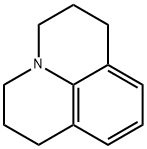
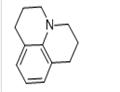
Julolidine used as amine building block and in chemoluminescent dye. Also used in photoconductive materials, chemiluminescence substances, chromogenic substrates in analytical redox reactions, dye intermediates, potential antidepressants and tranquilizers, nonlinear optical materials, high sensitivity photopolymerizable materials, and for improving color stability in photography.
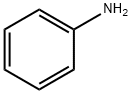
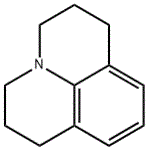
The general procedure for the synthesis of julolidine from aniline and 1,3-propanediol was as follows: aniline (1.0 mmol), IrCl3-3H2O (5.0 mol%, based on the amount of 1,3-propanediol), and rac-BINAP (7.5 mol%) were added to a reaction vial in air. Subsequently, homotrimethylbenzene (0.5 mL) and 1,3-propanediol (1.3 mmol) were added to the reaction vial and the reaction was stirred for 18 hours at 165 °C. After completion of the reaction, the reaction mixture was diluted with hexane and then filtered through filter paper. The filtrate was concentrated under vacuum and the resulting residue was purified by fast column chromatography on SiO2 (eluent ratio tBuOMe:hexane=1:15) to give 2,3,6,7-tetrahydro-1H,5H-benzo[ij]quinolizine as the final product.
Purify julolidine by dissolving it in dilute HCl, steam is bubbled through the solution and the residual acidic solution is basified with 10N NaOH, extracted with Et2O, washed with H2O, dried (NaOH pellets), filtered, evaporated and distilled in vacuo. The distillate crystallises on cooling (m 39-40o). It develops a red colour on standing in contact with air for several days. The colour can be removed by distilling or dissolving in 2-3 parts of hexane, adding charcoal, filtering and cooling in an Me2CO/Dry-ice bath when julolidine crystallises out (85-90% yield m 39-40o). The hydrobromide [83646-41-7] has m 218o (239-242o), the picrate has m 174o(165o) and the methiodide crystallises from MeOH, with m 186o [Glass & Weisberger Org Synth Coll Vol III 504 1955, Smith & Yu J Org Chem 17 1285 1952, Beilstein 20 H 332, 20 I 133, 20 II 214, 20 III/IV 3281.] Highly TOXIC.
[1] Synlett, 2018, vol. 29, # 18, p. 2385 - 2389