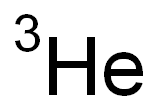
In nuclear fusion reactions, the energy released by the fusion of the three isotopes of hydrogen with helium-3 is the greatest of all nuclear fusion reactions. Therefore, helium-3 is the most ideal fuel for nuclear fusion.
Currently, the applications of helium-3 are limited, primarily in neutron detection and lung medical imaging. Helium-3 has a high thermal neutron absorption cross-section, making it the converter gas in neutron detectors. When helium-3 captures a neutron, it converts into a tritium ion and a hydrogen ion (proton), releasing 0.764 MeV of energy. By analyzing the composition of the produced gas, the neutron radiation dose of the radioactive material can be determined.
Helium-3,3He, has been known as a stable isotope since the middle-1930s and it was suspected that its properties were markedly different from the common isotope, helium-4.
The development of nuclear fusion devices in the 1950s yielded workable quantities of pure helium-3 as a decay product from the large tritium inventory implicit in maintaining an arsenal of fusion weapons.
- Radioligand binding assays in drugdiscovery
- Groundwater dating and hydrology research
- Self-luminous applications requiring long half-life
- Pharmaceutical formulation development
ChEBI: The stable isotope of helium with relative atomic mass 3.016029. The least abundant (0.000137 atom percent) isotope of naturally occurring helium.