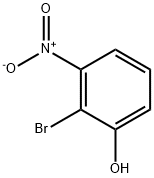
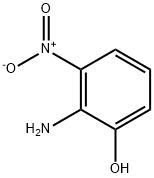
General procedure for the synthesis of 2-bromo-3-nitrophenol from 2-amino-3-nitrophenol: 2-amino-3-nitrophenol (5 g, 32.4 mmol) was dissolved in water (29.5 mL) and 1,4-dioxane (14.7 mL). The mixture was heated to reflux and hydrobromic acid (48%, 16.7 mL, 147 mmol) was added dropwise over 20 min. After addition, reflux was continued for 15 min. The reaction mixture was cooled to 0 °C (ice bath) and a solution of sodium nitrite (2.23 g, 32.3 mmol) in water (20 mL) was added over 30 min. Stirring was continued at 0 °C for 15 min, then the mixture was transferred to a pre-cooled jacketed dropping funnel (0 °C) and added dropwise to a stirred mixture of cuprous bromide (I) (5.34 g, 37.2 mmol) in water (29.5 mL) and hydrobromic acid (48%, 16.7 mL, 147 mmol). The reaction mixture was stirred at 0 °C for 15 min, then warmed to 60 °C, continued stirring for 15 min, cooled to room temperature, and stirred overnight. The reaction mixture was transferred to a partition funnel and extracted with ether (3 x 150 mL). The organic layers were combined, washed with brine (1 x 150 mL), dried (Na2SO3), filtered and concentrated to give the crude product (7.99 g) as a reddish brown oil. The crude product was extracted by fast column chromatography (1:25 ultrapure silica gel, 230-400 mesh, 40-60 mm, 60 ; CH2Cl2 as solvent) purified the crude product to afford pure 2-bromo-3-nitrophenol (45%, 3.16 g) as an orange-brown solid. Mass spectrum (MS) m/z: 217.8 (MH+). High performance liquid chromatography (HPLC, TFA) homogeneity at 220 nm: 97%.