Yellow crystalline powder, soluble in organic solvents such as methanol, ethanol, and DMSO, derived from licorice.
It is a natural product derived from plant source th at finds application in compound screening libraries, metabolomics, phytochemical, and pharmaceutical research.
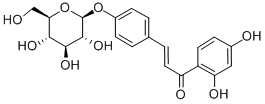
ChEBI: A monosaccharide derivative that is trans-chalcone substituted by hydroxy groups at positions 2' and 4' and a beta-D-glucopyranosyloxy group at position 4 respectively.
Isoliquiritin triggers apoptotic cell death by increasing the levels of p53 and p21 in A549 non-small cell lung cancer cells while also inhibiting the p53-dependent pathway and revealing interactions with Akt activities. Futher, Isoliquiritin has demonstrated neuroprotective activity against oxidative stress and has the capability to restrain the growth of microbial pathogens.
Isoliquiritin (0.31-3.1 mg/kg, i.p., once a day for 5 days) inhibits granuloma angiogenesis in mice[1].
Isoliquiritin (10-40 mg/kg, oral gavage) shows antidepressant-like effects in FST and TST tests in mice[2].
Isoliquiritin ((10 mg/kg/bw/day, p.o.) shows anti-oxidative and anti-Inflammatory properties, and relieves cationic BSA-Induced membranous glomerulonephritis in experimental rat model[5].
| Animal Model: | Mice in Forced Swimming Test (FST) and the Tail Suspension Test (TST)[2] |
| Dosage: | 10, 20 and 40 mg/kg |
| Administration: | oral gavage |
| Result: | Reduced the immobility time in the FST and TST in mice.
Increased 5-HT and NE level and Reduced the ratio of 5-HIAA/5-HT in the hippocampus, hypothalamus and cortex. |