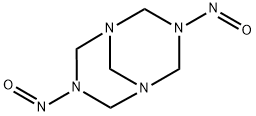
N,N'-DINITROSOPENTAMETHYLENETETRAMINE is a widely used foaming agent in the field of rubber foaming. It has advantages such as high foaming efficiency, no discoloration, and no pollution. It can be used as a foaming agent for adhesives or sealants. It is also a commonly used organic microporous foaming agent in the manufacture of sponge rubber and foamed plastics. It is easily dispersed in rubber compounds and is non-polluting, but its decomposition temperature is relatively high, and the decomposition products have an odor. Using salicylic acid, adipic acid, phthalic acid, etc. as foaming aids can adjust the decomposition temperature to 90-130℃. Urea can be used to eliminate the odor. The dosage in polyvinyl chloride is 7%-25%, and the dosage in rubber is 3%-5%. It is also used as a foaming agent for plastics such as rubber and polyvinyl chloride to manufacture microporous plastics.
Slightly yellow or light cream colored powder. Odorless, but has formaldehyde odor in humid air. Soluble in ethyl acetoacetate and dimethylformamide, slightly soluble in water and ethanol, slightly soluble in chloroform, pyridine, methyl ethyl ketone and acrylonitrile, almost insoluble in ether.
ChEBI: Dinitrosopentamethylenetetramine is a member of 1,3,5-triazinanes.
Flammable explosive solid.
Self-reactive. N,N'-DINITROSOPENTAMETHYLENETETRAMINE is a blowing agent with an exothermic decomposition slightly above its melting point of 203°C, Ellern, 161(1968). N,N'-DINITROSOPENTAMETHYLENETETRAMINE is shock sensitive.
Poison by intravenous,
intraperitoneal, and subcutaneous routes.
Moderately toxic by ingestion. Questionable
carcinogen. Mutation data reported. Can
ignite when handled and burns very rapidly.
Many N-nitroso compounds are
carcinogens. A blowing agent. When heated
to decomposition it emits toxic fumes of
NO,. See also N-NITROSO
COMPOUNDS.