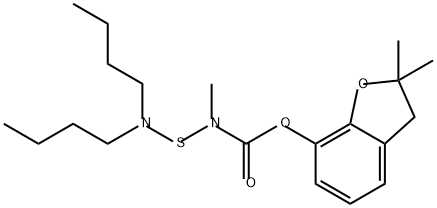
Brown sticky liquid. B.p. is124 ~ 128 ℃ (114 ℃). The flash point is 115~1,117℃, and the vapor pressure is 0.041 x 10⁻³Pa. The relative density is 1.056 (20℃). It can dissolve with acetone, ethanol and xylene, and the solubility in water is 0.3mg/L. The distribution coefficient is 157 (pH value is 7.05).
It has a fast decomposition in water, easily decomposed into carbofuran with pH<7. In the sun, when the 5 g/mL of Carbosulfan is in buffer solution with pH equaling to 7, the half-life period is 1.4d and 4 ~ 8d in distilled water.
- This product is a derivative of carbofuran, which has the same insecticidal activity as carbofuran .But its toxicity is much lower than carbofuran, a stomach insecticide .It can be metabolized into carbofuran in the organism and then play its effect to kill the insect. It has excellent control effect on the potato green peach aphid, black beetle, high dyed blind fly, cutworm and other insects. In addition, it can also better control cotton spider mite, billbug, tribolium confusum and spodoptera moth etc..
- Carbamate insecticides, acaridants and nematides with high absorbability and broad-spectrum properties. It is a low toxic variety of Carbosulfan for the control of citrus, fruit trees, cotton and rice crops of aphids, mites, wireworm, beet and potato beetles, a hidden food tea leafhopper, Grapholitha molesta, codling moth and other pests. The administration concentration is 5mg/L and the effective component is 6.8 ~ 15g /100m2.
- Low toxic insecticides with internal absorbability and broad-spectrum
- For the control of rust ticks, aphids, thrips, leafhoppers and other more than 10 kinds of pests on the fruit trees, cotton, vegetables, grain and other crops.
Preparation method 1:
Preparation of two n-butanamine sulphide Add two n-butyl amine and petroleum ether (60~90℃ ), mixing and cooling to 0℃ . Then slowly drip disulfur dichloride and maintain the temperature at 0~10 ℃. Afterwards, the reaction will be maintained at a constant temperature. The proportioning of the di-n-butylamine, disulfur dichloride and sulfuric chloride is 1:0.6:0.55(mol). The yield is 88%.
The synthesis of carbosulfan Two n-butanamine sulphur chloride reacts with carbosulfan with the ratio of 1:1. The reaction process is added with a proper amount of alkaline solution, and the reaction temperature is 10~20 ℃. The reaction time period is 2h. Add water and mix it for 10 minutes after the reaction. Filter it and the unreacted is carbosulfan which can be reused. The filtrate is stratified and the oil layer is decompressed and dissolving, and the yield is 90%.
Preparation method 2:
The synthesis of the intermediates hydroxyl compounds can be take the carbosulfan as reference. There are also literature reporting that starting from cyclohexanone and isobutyrate, five steps will be able to get it synthesized through condensation, chlorination, aromatization, hydrolysis and closed loop reaction. It is characterized by the synthesis of non aromatic compounds and is a highly selective synthesis route.
Oral administration-rats LD50: 51 mg / kg;
Oral administration - mouse LD50: 74 mg / kg
Combustion can produce toxic nitrogen oxides and oxygen sulfide.
Storage and transportation
The storeroom is ventilated and dry at low temperature.
Separate transportation from food raw materials.
Carbosulfan (8),2,3-dihydro-2,2-dimethylbenzofuran-
7-yl(dibutylaminothio)methylcarbamate(IUPAC),
is an orange to brown, clear viscous liquid (bp 124–128 C),
miscible with organic solvents and solubility 0.3 ppm in
water(25 C). It is closely related structurally to carbofuran,and like carbofuran, it is a cholinesterase inhibitor with
systemic activity.
Orange-yellow thick liquid.
Carbosulfan is an insecticide with contact and stomach action. It is
used to control a wide range of soil-dwelling and foliar pests in cotton,
sugar beet, potato, rice, fruit, maize, vegetables, sugar cane and coffee.
Carbosulfan is produced through a multi-step chemical synthesis starting from carbofuran, a related carbamate pesticide. The process begins by dissolving carbofuran in an organic solvent and adding triethylamine as an acid-binding agent. Then, sulphur dichloride is added dropwise to initiate a reaction that forms a sulphide intermediate. This intermediate is subsequently reacted with di-n-butylamine, 4-dimethylaminopyridine, and additional triethylamine to produce the final carbosulfan compound. After the reaction is complete, the mixture is washed until neutral, and the organic phase is separated and purified through decompression and desolventisation.
ChEBI: Carbosulfan is a member of 1-benzofurans and a carbamate ester. It has a role as an EC 3.1.1.7 (acetylcholinesterase) inhibitor, a carbamate insecticide, an acaricide, an agrochemical and a nematicide.
Thio and dithiocarbamates slowly decompose in aqueous solution to form carbon disulfide and methylamine or other amines. Such decompositions are accelerated by acids.
Carbosulfan is a thiocarbamate. Flammable gases are generated by the combination of thiocarbamates and dithiocarbamates with aldehydes, nitrides, and hydrides. Thiocarbamates and dithiocarbamates are incompatible with acids, peroxides, and acid halides.
Systemic with contact and stomach action. Acetylcholinesterase (AchE) inhibitor.
Carbosulfan is a carbamate insecticide
and a low toxic derivative from cabofuran. It is a broad
spectrum insecticide, nematicide, miticide, effective against
pests and mites. It is used to protect alfalfa, apple, citrus,
corn, deciduous fruit, potato, rice, sorghum, soybean, sugar
beets, sugarcane, and other vegetable, field, tree and
orchard crops. It is used for seed treatments
Carbosulfan is an N-sulfenyl-N-methylcarbamate which is effectively
a pro-insecticide of carbofuran. The latter is formed in vivo by the
biochemical or chemical thiolysis of carbosulfan. N-S Bond cleavage,
oxidation, conjugation and hydrolysis are the main metabolic routes
for carbosulfan in plants and animals. Carbosulfan is degraded via
carbofuran in soil. In plants, carbosulfan is metabolised via carbofuran to
3-hydroxycarbofuran (PM).
Itsmetabolic patterns are similar to those of carbofuran.
In rats, it rapidly undergoes hydrolytic and oxidative
processes followed by conjugation. It is not persistent in
soils, with DT50 ca. 2–5 days, and it was rapidly degraded
to carbofuran in a sandy loam soil (4). Carbofuran was
subsequently hydrolyzed at the carbamate ester group
to form the phenol carbofuran or oxidized at the 3-
position. Biscarbofuran disulfide and minor products were
also detected. Carbofuran was also formed in soils by
nonbiological degradation processes.
UN2992 Carbamate pesticides, liquid, toxic,
Hazard Class: 6.1; Labels: 6.1-Poisonous materials;
UN2810 Toxic liquids, organic, n.o.s., Hazard Class: 6.1;
Labels: 6.1-Poisonous materials, Technical Name Required.
Carbosulfan is hydrolysed in aqueous media most rapidly under acidic
conditions. Its DT50 values (25 °C) at pH 4,6 and 7 were <1 hour, 22 hours
and 7.6 days respectively (PM). In a variety of aqueous solvents there was
facile cleavage of the N-S carbamate bond of carbosulfan to yield carbofuran
(2) as the sole or major product (see Scheme 1) (Umetsu et al., 1980).
A solution of [14C]carbosulfanin propylene glycol was treated with 0.001
or 0.01 N aqueous HCl at 40 °C. Solutions were analysed at intervals up to
24 hours. Carbosulfan was relatively stable with more than 40% being
recovered after 24 hours in the solution of lower acidity. Carbofuran (2)
was the principal transformation product in hydrochloric acid. Biscarbofuran
disulfide (3) was present in only trace amounts and small
amounts of polysulfides of carbosulfan (4,n = 2-6) were detected (Umetsu
and Fukuto, 1982).
Carbosulfan was quite stable in neutral and alkaline media. [14C-carbonyl]-
or [14C-dibutylamino]Carbosulfan dissolved in dichloromethane:
acetic acid (9:l) converted to a range of products via N-S bond cleavage.
The principal products were carbofuran (2), dibutylamine and a mixture
of polysulfide derivatives: bis-carbofuran disulfide (3) and a mixture of
bis-carbofuran polysulfides (5). Structures of products were confirmed by
MS and NMR (Umetsu et al., 1981a,b).
Carbamates are incompatible with strong
oxidizing acids, peroxides, and hydro-peroxides; strong
reducing agents such as hydrides; strong acids and bases.
Contact with nitrides or chemically active metals (aluminum, copper, magnesium, neptunium, sodium, tin, titanium,zinc, etc.) causes the release of potentially explosive hydrogen gas and a metal salt.
Do not discharge into drains
or sewers. Dispose of waste material as hazardous waste
using a licensed disposal contractor to an approved landfill.
Consult with environmental regulatory agencies for guidance on acceptable disposal practices. Incineration with
effluent gas scrubbing is recommended. In accordance
with 40CFR165, follow recommendations for the disposal
of pesticides and pesticide containers. Noncombustible containers should be crushed and buried under more than
40 cm of soil. Must be disposed properly by following
package label directions or by contacting your local or federal environmental control agency, or by contacting your
regional EPA office.