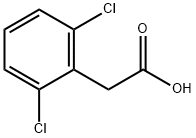
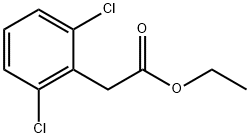
The general procedure for the synthesis of 2,6-dichlorophenylacetic acid from ethyl 2,6-dichlorophenylacetate was as follows: first, 2,6-dichlorotoluene (2.4 g), ethanol (46 mg), di-tert-butyl peroxide (73 mg, 1 eq.), and Pd(Xantphos)Cl2 (3.8 mg, 1 mol%) were added to a reactor and charged with carbon monoxide at 10 atmospheres. The reaction mixture was heated to 120°C and stirred continuously at this temperature for 16 hours. Upon completion of the reaction, carbon monoxide was released and purified by column chromatography to give 84 mg of ethyl 2,6-dichlorophenylacetate in 72% yield. The structure of the product was determined by 1HNMR (400 MHz, CDCl3) δ 1.25 (t, J=7.2 Hz, 3H), 4.01 (s, 2H), 4.17 (q, J=7.2 Hz, 2H), 7.14-7.18 (m, 1H), 7.31-7.33 (m, 2H); 13CNMR (100 MHz, CDCl3) δ 14.2,36.8,61.1,128.0,128.9,131.4,136.1,169.5; HRMS (ESI) calculated value of C10H10Cl2NaO2 [M+Na] was confirmed by analytical calculations of C10H10Cl2NaO2 [M+Na]: 254.9950 and measured value: 254.9949. Subsequently, the resulting ethyl 2,6-dichlorophenylacetate was dissolved in 1,4-dioxane, 6N sodium hydroxide solution was added and the reaction mixture was heated to 60°C. After 2 hours of reaction, the pH was adjusted with 2N hydrochloric acid to 1. After removal of the organic solvent under reduced pressure, the mixture was extracted with ethyl acetate to give 71 mg of 2,6-dichlorophenylacetic acid in 95% hydrolysis yield.