Phorbol 12-myristate 13-acetate
- Product NamePhorbol 12-myristate 13-acetate
- CAS16561-29-8
- MFC36H56O8
- MW616.83
- EINECS605-413-5
- MOL File16561-29-8.mol
Chemical Properties
| Melting point | 65-79oC |
| Boiling point | 571.87°C (rough estimate) |
| Density | 1.17±0.1 g/cm3 (20 ºC 760 Torr) |
| refractive index | 1.4900 (estimate) |
| storage temp. | -20°C |
| solubility | DMSO: DMSO solutions can be stored dark at −20°C for at least six months.soluble |
| pka | 11.19±0.70(Predicted) |
| form | Fine Crystalline Powder |
| color | Off-white to light yellow |
| Water Solubility | Very soluble in methanol, soluble in DMSO, chloroform, ethanol or acetone, ether, ethyl acetate, DMF or acetonitrile. Insoluble in water. |
| Sensitive | Light Sensitive |
| BRN | 2407201 |
| Stability | Stable for 2 years from date of purchase as supplied. Solutions in DMSO or ethanol may be stored at -20° for up to 2 months. |
| InChIKey | PHEDXBVPIONUQT-RGYGYFBISA-N |
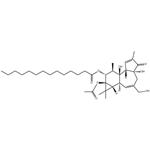
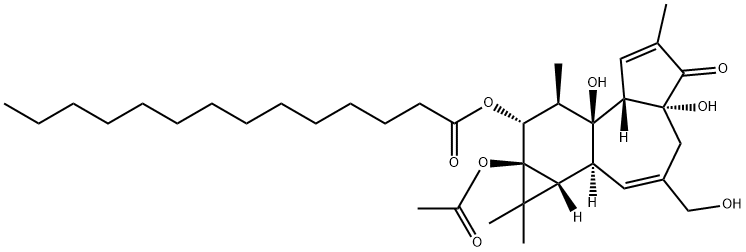
| SMILES | CCCCCCCCCCCCCC(=O)O[C@@H]1[C@@H](C)[C@@]2(O)C(C=C(CO)C[C@@]3(O)C2C=C(C)C3=O)C4C(C)(C)[C@]14OC(C)=O |
| CAS DataBase Reference | 16561-29-8(CAS DataBase Reference) |
| EPA Substance Registry System | 12-O-Tetradecanoylphorbol 13-acetate (16561-29-8) |
Safety Information
| Hazard Codes | Xi |
| Risk Statements | 38-36/37/38 |
| Safety Statements | 36/37-26 |
| RIDADR | 2928 |
| WGK Germany | 3 |
| RTECS | QH4377000 |
| F | 8-10 |
| HazardClass | 6.1(a) |
| PackingGroup | II |
| HS Code | 29153900 |
| Storage Class | 6.1A - Combustible acute toxic Cat. 1 and 2 very toxic hazardous materials |
| Hazard Classifications | Acute Tox. 1 Dermal Acute Tox. 1 Inhalation Acute Tox. 2 Oral Carc. 2 Eye Dam. 1 Resp. Sens. 1 Skin Corr. 1B Skin Sens. 1 |
| Hazardous Substances Data | 16561-29-8(Hazardous Substances Data) |
| Toxicity | Diesters of phorbol, particularly 12-O-tetradecanoylphorbol 13-acetate, also known as phorbol myristate acetate, have been identified as the potent, highly lipophilic tumor-promoting components in croton oil. They are potent promoters of skin tumors in vivo and have been shown to transform cultured fibroblasts and embryonic cells previously exposed to polycyclic aromatic hydrocarbon carcinogens in vitro. The structure of phorbol, the parent alcohol is shown below. Phorbol esters also have important effects on leukocytes and on the immune system of the intact animal. There appears to be a specific receptor for phorbol esters on T cells, a finding that may account for the selective toxicity of phorbol esters for T cells. The mechanism of tumor promotion by phorbol esters is still largely unknown, but findings suggest an initial cell membrane interaction (often with stimulation of second messenger synthesis and increased protein kinase activity), with subsequent effects on nuclear regulatory events. |