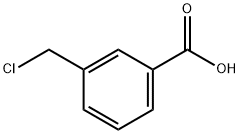
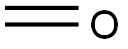
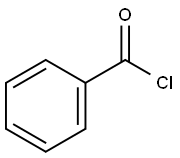
The general procedure for the synthesis of 3-(chloromethyl)benzoic acid from formaldehyde and benzoyl chloride was as follows: 50 mL of chloroform and 20 mL of carbon tetrachloride were added to an autoclave. Subsequently, 0.1 mol of benzoyl chloride, 0.13 mol of paraformaldehyde and 0.02 mol of anhydrous manganese dichloride were added to it and nitrogen was charged to a pressure of 0.5 MPa. The reaction mixture was allowed to react at a constant temperature of 40-50 °C for 12 h. After the reaction was completed, the mixture was cooled down to a temperature of 0.5 °C. The reaction was carried out at a temperature of 0.5 °C. Upon completion of the reaction, the mixture was cooled to room temperature and the nitrogen was slowly released. The reaction solution was poured into 100 mL of ice water, stirred for 0.5 h, and left to stratify. The organic layer was concentrated under reduced pressure to give the crude product. A portion of the crude product was taken and analyzed by HPLC, which showed that the crude product contained 0.5% benzoic acid and 95.6% 3-(chloromethyl)benzoic acid.