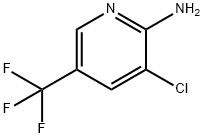
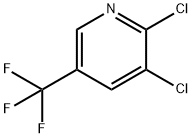
Example 1: General procedure for the synthesis of 2-amino-3-chloro-5-trifluoromethylpyridine from 2,3-dichloro-5-trifluoromethylpyridine
1. Ammonolysis reaction: 2,3-dichloro-5-trifluoromethylpyridine (26.75 g, 0.125 mol) and water (25 ml) were added to an autoclave. After sealing, liquid ammonia (45 g, 2.85 mol) was added through a pressure bottle. The reaction mixture was heated to 80 °C and maintained for 9 h at 18-22 bar pressure. After cooling to room temperature, the intermediate 2-amino-3-chloro-5-trifluoromethylpyridine was obtained by filtration, washed with water and dried (22 g, 90% yield).
2. Condensation reaction: the above intermediate was dissolved in acetonitrile (230 ml), cooled to 5 ℃ and added solid KOH (12 g, 0.22 mol). A solution of 2,4-dichloro-3,5-dinitro-5-trifluoromethylbenzene (25 g, 0.08 mol) in acetonitrile (230 ml) was added slowly over 15 min under continuous cooling conditions. The reaction was gradually warmed up to 25°C for 4 hours and subsequently warmed up to 40°C for 2 hours.
3. Post-treatment: The reaction mixture was poured into water (1500 ml) and the pH was adjusted to about 4 with a 4N aqueous hydrochloric acid solution, followed by extraction with isopropyl acetate (2 x 750 ml). The organic phases were combined and concentrated to dryness to give the crude fludioxamine (43 g, 70% yield, 60% purity). The target product can be further purified by recrystallization.