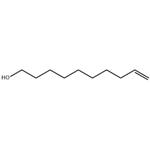
Powerful, fatty-oily, waxy-rosy odor of considerable tenacity. The rosy notes are particularly conspicuous in dilutions, best at 1%
or lower, while higher concentrations bring
about more waxy-oily notes.
9-Decen-1 (cipher)-ol has been identified as a trace
constituent of cognac. It is a colorless liquid with a fresh, dewy, rose note that can
be prepared by partial dehydration of 1,10-decanediol. It is used in rosy, floral soap
perfumes.
9-DECEN-1-OL is colorless oily Iiquid.
Practically insoluble in water, soluble in
alcohol and oils.
Apparently has not been reported to occur in nature.
It finds it uses in a wide range of fragrances, especially in fine fragrances and soaps, in floral, rose petal or herbal fragrances. 9-Decen-1-ol is used in the preparation of semifluorinated acids required for the synthesis of poly(styrene-b-semi fluorinated isoprene) block copolymers with -CF2H-terminated side groups.
9-Decen-1-ol was used in the preparation of semifluorinated acids required for the synthesis of poly(styrene-b-semifluorinated isoprene) block copolymers with -CF2H-terminated side groups.
ChEBI: 9-Decen-1-ol is an aliphatic alcohol.
From 1,10-decamethylene glycol (Arctander, 1969).
9-Decen-1-ol undergoes oxidation to give 9-decenoic in aqueous media (dioxane–water mixtures) in the presence of supported palladium or platinum catalysts.
Rosalva (IFF), Trepanol® (Takasago).
The synthesis of 9-decenol was
conducted in three phases, and undecylenic
acid was used as initial substance in
this synthetic procedure. The key phase in
this synthesis is the oxidative
decarboxylation of undecylenic acidup
to 9-decyl-chloride, as shown on the
scheme.

In a round flask of 50ml, equipped with reverse condenser and a magnetic mixer, 1.9g (0.01mol) of 9-decenyl-acetate is placed, 0.56g (0.01 mol) of potassiumhydroxide, 3ml H2O and 2ml of methanol. The mixture is heated and left to boil for 1- 2 hours on the oil bath. After the completion of the reaction, the solution is cooled down, 3ml of water is added and the then it is acidified with diluted hydrochloric acid. The organic layer is extracted with ether and left to dry with anhydrous sodium-sulfate. Ether and methanol are separated with normal pressure distillation, and the rest of the solution is distilled under the lowered pressure. Unsaturated alcohol, 9-decenol (4) is distilled at T=155℃ or at 120℃ under the pressure of 533.289 Pa. The obtained 9-decenol is 1.575g (86%) in comparison to the used ether, that is 30.48% in comparison to the initial undecylenic acid.
[1]
[1] SUNCICA JOVIC Lidija J S. Synthesis of 9-decen-1-ol[J]. Journal of Process Management New Technologies, 2018, 6 1: 27-31. DOI:10.5937/JOUPROMAN6-16258.