It is a natural product derived from plant source th at finds application in compound screening libraries, metabolomics, phytochemical, and pharmaceutical research.
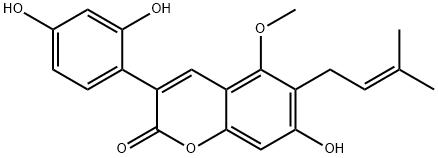
ChEBI: A member of the class of coumarins that is coumarin substituted by a hydroxy group at position 7, a methoxy group at position 5, a prenyl group at position 6 and a 2,4-dihydroxyphenyl group at position 3. Isolated from Glycyrrhiza uralensis,
it exhibits antispasmodic activity.
Glycycoumarin is an isoflavone from vegetable roots including licorice th at exhibits potent hepatoprotective effects. Glycycoumarin protects hepatocytes through activation of autophagy and mitigation of ER stress/GSK-3 –JNK/CHOP-mitochondria cascade activation. Also, it appears to alleviate acetaminophen-induced liver injury through sustained autophagy.
Glycycoumarin (30 μM-0.3 nM; 5 min) has an inhibitory effect on smooth muscle contraction induced by various types of stimulants through the inhibition of PDEs, especially isozyme 3, followed by the accumulation of intracellular cAMP[1].
Glycycoumarin (10 mg/kg; i.p.; once daily for 4 d) enhances tumor growth inhibition in HepG2 xenograft model in mice and shows synergistical effect with ABT-737 (HY-50907)[2].
| Animal Model: | Male ICR mice (aged 6 weeks, weight 25-30 g)[1] |
| Dosage: | 30 μM-0.3 nM, 5 min |
| Administration: | |
| Result: | Inhibited the contraction induced by various types of stimulants, such as CCh, KCI, BaCI(2), and A23187 (calcium ionophore III).
Enhanced the relaxation induced by forskolin on CCh-evoked contraction and also enhances the relaxation effect of rolipram.
Associated with dose-dependent accumulation of cAMP.
|
| Animal Model: | HepG2 cancer cells xenograft model in male BALB/c athymic nude mice (6-7 weeks old)[2] |
| Dosage: | 10 mg/kg |
| Administration: | Intraperitoneal injection; once daily for 4 days; ABT-737 group was given 100 mg/kg i.p. |
| Result: | Inhibited tumor growth and resulted a reduction of the final tumor weight by 17%. |