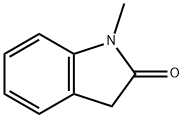
1-Methyl-2-indolone is a reactant for preparation of fluorescent analogues of strigolactones as affectors of parasitic weed germination and fungal branching, irreversible Nek2 Kinase Inhibitors and anticancer agents.
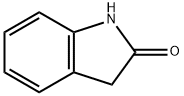
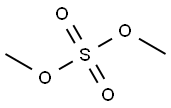
To a 5 L four-necked flask (equipped with a mechanical stirrer, condenser tube and nitrogen inlet) was added 2 L of water and 50% sodium hydroxide solution (2.52 mol, 201.6 g, 2.25 eq.) followed by 2-indolone (1.12 mol, 150 g, 1 eq.). The reaction mixture was heated to 40 °C. Dimethyl sulfate (1.68 mol, 211.7 g, 159 mL, 1.5 eq.) was slowly added dropwise via a syringe, the reaction was exothermic during the dropwise addition and the temperature was raised to 53°C. After the dropwise addition, the reaction mixture was heated to 100 °C and maintained for 15 minutes. After the reaction mixture was cooled to 60 °C, the second portion of dimethyl sulfate (0.476 mol, 60 g, 45 mL, 0.425 eq.) was added and the reaction mixture was again heated to 100 °C and maintained for 15 min. The progress of the reaction was monitored by TLC (unfolding agent: heptane/ethyl acetate, 1:1) to confirm that the methylation reaction was essentially complete. The reaction mixture was cooled to 50 °C and the pH was adjusted with concentrated hydrochloric acid to about 7. After inoculation of the crystal seed, the mixture was cooled to room temperature and allowed to stand overnight. The solid product was collected by filtration, washed four times (4×) with water, and subsequently dried under vacuum at 40 °C overnight to afford 1-methyl-2-indolinone 110.7 g (67% yield) as a pink solid with a melting point of 84-86 °C. The reaction was carried out in the presence of a strong hydrochloric acid.
[1] Organic Letters, 2012, vol. 14, # 10, p. 2544 - 2547
[2] Tetrahedron Letters, 2015, vol. 56, # 26, p. 3992 - 3995
[3] Chemistry - An Asian Journal, 2017, vol. 12, # 7, p. 734 - 743
[4] Journal of Organic Chemistry, 2010, vol. 75, # 4, p. 1047 - 1060
[5] Tetrahedron Letters, 2001, vol. 42, # 41, p. 7315 - 7317