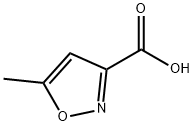
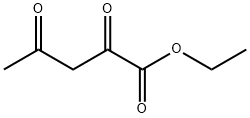
The general procedure for the synthesis of 5-methylisoxazole-3-carboxylic acid from ethyl acetylacetonate was as follows: 107 mL of ethanol was added to a 500 mL round-bottomed flask, followed by the sequential addition of sodium bicarbonate (13.2 g, 0.157 mol), hydroxylamine hydrochloride (10.91 g, 0.157 mol) and ethyl 2,4-dioxovalerate (25 g, 0.157 mol). The reaction mixture was refluxed for 4 hours. After completion of the reaction, the precipitate was collected by filtration and the filtrate was concentrated under vacuum to give the intermediate ester. The ester was dissolved in 53.5 mL of ethanol and sodium hydroxide solution (59 mL, 10%) was added slowly. The reaction mixture was stirred at room temperature overnight. Subsequently, the solvent was removed by evaporation under reduced pressure. The resulting sodium salt was dissolved in water and acidified with concentrated hydrochloric acid until precipitation precipitated 5-methylisoxazole-3-carboxylic acid. The crude product was purified by recrystallization from EtOAc to give a final white crystalline product with a melting point of 172-174 °C (literature value 182 °C). The yield was 79%. The product was characterized by 1H NMR (DMSO-d6): δ 2.3 (3H, s, CH3), 6.6 (1H, s, CH), 7.0 (1H, s, COOH).IR spectroscopy (KBr) showed the O-H stretching vibration of 5-methylisoxazole was located at 3,149 cm-1 and the C=O stretching vibration was located at 1,655.35 cm-1.Elemental analyses showed results in accordance with the theoretical calculated values of C, H, N and O.