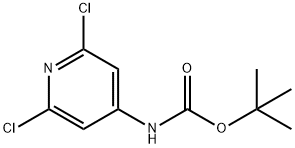
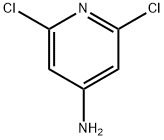
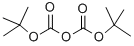
Step 1. 4-Amino-2,6-dichloropyridine (5.04 g, 30.3 mmol) was dissolved in dichloromethane (DCM, 100 mL) at room temperature, and 4-dimethylaminopyridine (DMAP, 0.61 g, 4.99 mmol) and di-tert-butyl dicarbonate (Boc2O, 13.71 g, 60.9 mmol) were added sequentially. The reaction mixture was stirred at room temperature overnight. Upon completion of the reaction, the organic phase was washed sequentially with saturated aqueous ammonium chloride solution (3 × 30 mL) and brine (40 mL), followed by drying and concentration with anhydrous sodium sulfate. The residue was dissolved in a solvent mixture of tetrahydrofuran (THF, 30 mL) and water (30 mL) and sodium hydroxide (4.5 g, 112 mmol) was added. The reaction mixture was heated at 65 °C for 4 h. After cooling to room temperature, it was extracted with ethyl acetate (EtOAc, 5 × 30 mL). The organic phases were combined and washed sequentially with 1N hydrochloric acid (2 × 30 mL) and water (40 mL), followed by drying and concentration with anhydrous sodium sulfate to give a solid product. The solid was collected by filtration, washed sequentially with 1N hydrochloric acid (4 × 10 mL) and water (20 mL), and finally dried in a vacuum oven at 50 °C to afford N-Boc-4-amino-2,6-dichloropyridine (7.44 g, 93% yield) as a white solid.