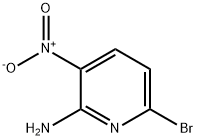
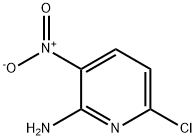
2,6-Dichloro-5-nitropyridine (20.0 g, 95.3 mmol) was used as a raw material, which was dissolved in ethanol (300 mL) and ammonia (60 mL) was added slowly. The reaction mixture was stirred at room temperature for 10 hours. After the reaction was completed, the precipitate was collected by filtration, washed with ethanol and dried under vacuum to obtain 6-amino-2-chloro-5-nitropyridine (13.8 g, 83% yield). The resulting 6-amino-2-chloro-5-nitropyridine was suspended in 30% hydrogen bromide in acetic acid solution (130 mL). The suspension was heated to 100 °C and stirred for 26 hours. After completion of the reaction, it was cooled to room temperature and concentrated in vacuum to remove the solvent. The residue was extracted with ethyl acetate and the organic layer was washed sequentially with saturated aqueous sodium bicarbonate and saturated brine, dried over anhydrous magnesium sulfate and concentrated in vacuum. The final product 6-bromo-3-nitropyridin-2-amine was purified by recrystallization from ethyl acetate to give white crystals (14.93 g, 86% yield).