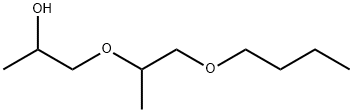
Dipropylene glycol butyl ether (DPnB) is a colorless, transparent liquid with a slight ether odor and bitter taste. It is soluble in water and possesses good binding properties, exhibiting excellent solubility and binding performance with coating resins, making it an outstanding film-forming aid. As a commonly used film-forming aid in water-based coatings, DPnB plays a significant role. Firstly, it improves film-forming properties. However, DPnB has poor hydrophilicity and is prone to demulsification in some water-based emulsions, requiring careful use. A major benefit of DPnB is its ability to improve the viscosity of water-based coating systems, especially multi-solvent systems where thickeners are ineffective. DPnB, combined with a neutralizing agent, can significantly increase coating viscosity, providing good storage properties and preventing sagging and blooming when thinned for spraying. DPnB also improves the defoaming properties of water-based coatings, aiding in defoaming during both production and application.
Dipropylene glycol butyl ether (DPnB) possesses high film-forming efficiency and a medium-to-slow evaporation rate, making it suitable for applications in the following areas:
1) Coatings: One of the most effective film-forming aids for water-based coatings, imparting excellent film properties; it can also act as a coagulant for acrylic resins, styrene acrylic resins, and polyvinyl acetate, further enhancing film performance. It is one of the most effective film-forming aids for many water-based coatings.
2) Cleaning agents: Suitable for use in cleaning agents, especially in systems requiring extremely low evaporation rates, such as wax removers and floor cleaners. It is an excellent coupling agent for greases and oils, and can be used as a paint remover and animal fat remover.
3) Other applications: Agricultural products, cosmetics, electronic inks, textiles.
Propylene glycol butyl ether and propylene oxide in a molar ratio of 1~5:1 with the amount of 0.01~0.05% (w) of perchlorate (catalyst) together with the high-pressure reaction kettle, through the nitrogen replacement for 3~5 times, under the condition of stirring, the temperature is increased to 100~150 C, the reaction pressure is 0.2-0.5 MPa, the reaction 1~2h, propylene glycol butyl ether, dipropylene glycol butyl ether and a small amount of tripropylene glycol butyl ether mixture, and the product is separated by continuous distillation. The mixture of propylene glycol butyl ether, dipropylene glycol butyl ether and a small amount of tripropylene glycol butyl ether is obtained.