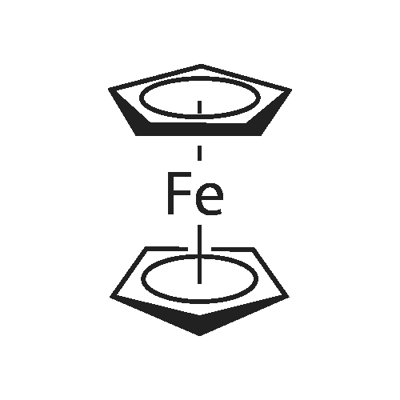
Ferrocene (Fc), which was discovered in 1951, is one of themost stable organometallic compounds. The interesting charac-teristic features of ferrocenes depend on reversible redoxproperties and a sandwich-shaped structure with two rotatorycoplanar cyclopentadienyl (Cp) rings. Another Intriguing structural feature of ferrocene is that theinter-ring distance between the two rotatory Cp rings is about 3.3 Å, which is appropriate for hydrogen bonding betweenattached peptide chains on two Cp rings. Secondary structuressuch as α- helices, β-sheets, and β-turns are formed dependingon the hydrogen bonds, which play key factors in proteinfoldings to fulfill unique functions as observed in enzymes,receptors, etc[1].
Ferrocene is an organic transition metal compound that has aromatic properties and is also known as dicyclopentadienyl iron. Its molecular structure contains a divalent iron cation and two cyclopentadienyl anions. It is used as a raw material in the production of ferrocenecarboxylic acid and was first successfully produced in the 1950s by reacting cyclopentadienyl magnesium bromide with anhydrous ferric chloride. Ferrocene is a non-polar compound that appears as an orange needle crystal powder with a camphor-like smell at room temperature. It is soluble in many organic solvents, including methanol, ethanol, ethyl ether, petroleum ether, gasoline, kerosene, diesel oil, methylene chloride, benzene, toluene, and xylene. Ferrocene has a molecule with polarity, high thermal stability, chemical stability, and radiation resistance, making it useful in industry, agriculture, medicine, aerospace, energy, environmental protection, and other fields.
Ferrocene and its derivatives have various applications in different fields. It can be used as additives in rocket fuel, antiknock agent in gasoline, curing agent in rubber and silicone resin, and ultraviolet absorber. It can also be used in the production of metal-containing polymers and as a coating material for spacecraft. Ferrocene has a smoke abatement and combustion facilitating effect, which can reduce smoke production and increase power efficiency in fuel. It can also be used as an iron fertilizer for plants and as a pesticide. Ferrocene derivatives have applications as antioxidants, stabilizers, catalysts, and promoting agents in different industrial and organic synthesis processes. Addition of ferrocene to fuels such as diesel, gasoline, heavy oil, and coal can decrease the fuel consumption rate and reduce smoke production. Overall, ferrocene has unique characteristics that make it suitable for various applications in different fields.
Oral-rat LD50: 1320 mg/kg; Oral-Mouse LD50: 832 mg/kg.
Flammability and hazard characteristics
flammable with the combustion generating iron-containing acrid smoke
warehouse: ventilated, low temperature and dry; Store it separately from oxidants.
Water, carbon dioxide, dry, sandy soil.
TWA 10 mg/m³; STEL 20 mg/m3
Ferrocene, a metallocene, appears as bright orange salt-like crystals when crystallized from alcohol. It has a camphor-like odor and forms an orange crystalline solid. The compound is insoluble in water but soluble in benzene, ether, and alcohol, with an iron content of 29.4–30.6%.

Orange crystals; camphor-like odor; melts at 172.5°C; vaporizes at 249°C; sublimes above 100°C; thermally stable above 500°C; insoluble in water; soluble in alcohol, ether and benzene; also soluble in dilute nitric acid and concentrated sulfuric acid forming a deep red solution that fluoresces.
Ferrocene
is used as a catalyst for vulcanization, acceleration, and
polymerization, as a chemical intermediate for polymeric
compounds such as high temperature polymers, as an antiknock
additive for gasoline, as a coating for missiles and
satellites, and as a high-temperature lubricant.
ferrocene: An orange-red crystallinesolid, Fe(C5H5)2; m.p. 173°C. Itcan be made by adding the ioniccompound Na+C5H5- (cyclopentadienylsodium, made from sodium andcyclopentadiene) to iron(III) chloride.In ferrocene, the two rings are parallel,with the iron ion sandwiched betweenthem (hence the namesandwich compound: see formula).The bonding is between pi orbitalson the rings and d-orbitals on theFe2+ ion. The compound can undergoelectrophilic substitution on theC5H5rings (they have some aromatic character).It can also be oxidized to theblue ion (C5H5)2Fe+. Ferrocene is the first of a class of similar complexescalled sandwich compounds. Its systematicname is di-π-cyclopentadienyliron(II).
Ferrocene is produced from the reaction of cyclopentadiene
with reduced iron in the presence of metal oxides. There is
also a two-stage production process in which produced iron
(II)oxide (stage 1) is reacted with cyclopentadiene.
Ferrocene, the most well-known cyclopentadienyl sandwich compound, contains up to 30% iron. It is primarily used as an organometallic framework and is widely applied in fields such as aerospace, petroleum, chemical engineering and biomedicine. For example:
(1) Biomedicine: Research has revealed that ferrocene and its derivatives possess a wide range of pharmacological activities, such as anti-anaemic, antibacterial, anti-proliferative, anti-malarial, anti-tubercular and antiviral properties. Consequently, it can be utilised in the development of drug candidates for the treatment of iron-deficiency anaemia, cancer (e.g. tamoxifen, a drug used to treat hormone-dependent breast cancer) and malaria (e.g. chloroquine) [2].
(2) Aerospace sector: Among various catalysts for combustion rates, ferrocene and its derivatives demonstrate excellent catalytic performance. Currently, ferrocene-based catalysts for the oxidation of solid rocket propellants are in widespread use [3].
(3) Chemical Industry: Ferrocene is a well-known iron precursor molecule for depositing iron-containing films in processes such as chemical vapour deposition (CVD) and can be used to prepare iron nanoparticles. Ferrocene precursors are commonly used as suspension catalysts in the synthesis of carbon nanotubes (CNTs)[4]. Furthermore, it can serve as an iron source for the manufacture of low-cost catalyst supports used in fixed-bed CVD synthesis of carbon nanotubes.
(4) Petroleum sector: Ferrocene can be added to kerosene or diesel to enhance combustion efficiency and reduce carbon monoxide emissions, thereby achieving energy savings and reducing atmospheric pollution.
Ferrocene appears as orange crystalline solid or orange-yellow powder. Sublimes above 212 °F. Camphor odor. (NTP, 1992)
Sensitive to prolonged exposure to air and may be sensitive to light. Insoluble in water.
Ferrocene reacts violently with tetranitromethane. . Contact of tetranitromethane with Ferrocene under various conditions leads to violent explosion, [Trans. Met. Chem., 1979, 4, 207-208].
Moderate fire risk. Evolves toxic products
on decomposition and heating.
Dicyclopentadienyl iron causes
changes in blood parameters and hepatic
cirrhosis.
The toxicological properties of dicyclopentadienyl
iron have not been extensively
investigated. However, it has been used as a
preventive and therapeutic iron deficiency
drug, and its utilization is listed as tolerable.
Flash point data for Ferrocene are not available. Ferrocene is probably combustible.
Flammability and Explosibility
Highly flammable
core: iron
reagent type: catalyst
Poison by
intraperitoneal and intravenous routes.
Moderately toxic by ingestion. Questionable
carcinogen with experimental tumorigenic
data. Mutation data reported. Flammable;
reacts violently with NH4ClO4. When heated
to decomposition it emits acrid smoke and
irritating fumes.
Used as additive in fuel oil; antiknock
agent in gasoline fuel; used in making rubber, silicone
resins, high-temperature polymers and lubricants; interme diate for high-temperature polymers; as a smoke suppres sant and catalyst
If this chemical gets into the eyes, remove anycontact lenses at once and irrigate immediately for at least15 min, occasionally lifting upper and lower lids. Seek medical attention immediately. If this chemical contacts theskin, remove contaminated clothing and wash immediatelywith soap and water. Seek medical attention immediately. Ifthis chemical has been inhaled, remove from exposure,begin rescue breathing (using universal precautions, including resuscitation mask) if breathing has stopped and CPR ifheart action has stopped. Transfer promptly to a medicalfacility. When this chemical has been swallowed, get medical attention. Give large quantities of water and inducevomiting. Do not make an unconscious person vomit.
Ferrocene was administered by
intramuscular injection at a dose of 5175 mg/kg/2 years.
By the criterion established by the Registry of Toxic Effects
of Chemical Substances (RTECS), ferrocene was an equivocal
tumorigenic agent and tumors were most evident at the
site of multiple injections.
Color Code—Red: Flammability Hazard: Store ina flammable materials storage area. Prior to working withthis chemical you should be trained on its proper handlingand storage. Store in tightly closed containers in a cool,well-ventilated area away from oxidizers, ammonium perchlorate, tetranitromethane, mercury(II) nitrate, and heat.Sources of ignition, such as smoking and open flames, areprohibited where this chemical is used, handled, or stored ina manner that could create a potential fire or explosionhazard.
UN1325 Flammable solids, organic, n.o.s.,
Hazard Class: 4.1; Labels: 4.1-Flammable solid.
Purify it by crystallisation from pentane or cyclohexane (also *C6H6 or MeOH can be used). It is moderately soluble in Et2O and sublimes readily above 100o. Crystallisation from EtOH gave material m 172.5-173o. [Wilkinson Org Synth Coll Vol IV 473 1963, Miller J Chem Soc 632 1952.] It has also been crystallised from methanol and sublimed in vacuo. [Saltiel et al. J Am Chem Soc 109 1209 1987, Beilstein 16 IV 1783.]
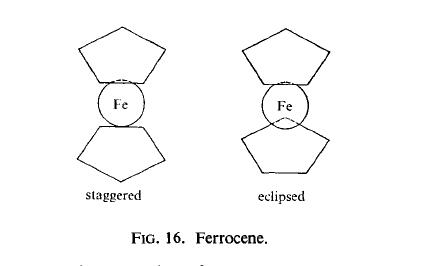
Structure and conformation
X-ray diffraction studies show that in crystalline ferrocene (and in its
substituted derivatives) the iron atom is "sandwiched" between the two cyclopentadienyl
rings, these rings having the staggered configuration relative to each other (Fig. 16). The
rings are parallel plane regular pentagons, all the C-C and Fe-C distances being equal.
Electron diffraction studies show, however, that ferrocene has the eclipsed configuration
in the vapour state.
Violent reaction with ammonium per chlorate, tetranitromethane, mercury(II) nitrate. Incompa tible with oxidizers (chlorates, nitrates, peroxides, perman ganates, perchlorates, chlorine, bromine, fluorine, etc.);
contact may cause fires or explosions. Keep away from
alkaline materials, strong bases, strong acids, oxoacids,
epoxides.
Peroxomonosulfuric acid. Decomposes @≧465 ℃.
[1] Moriuchi, Prof. T. (2021). Helical Chirality of Ferrocene Moieties in Cyclic Ferrocene-Peptide Conjugates. European Journal of Inorganic Chemistry, 2022 5. https://doi.org/
10.1002/ejic.202100902[2] Snegur, L. (2022). Modern Trends in Bio-Organometallic Ferrocene Chemistry. Inorganics. https://doi.org/
10.3390/inorganics10120226[3] Weidong Zhou. (2016). Progress on the synthesis and catalytic and anti-migration properties of ferrocene-based burning rate catalysts. Applied Organometallic Chemistry, 30 9, 796–805. https://doi.org/
10.1002/aoc.3502[4] Martin Lubej, Igor P. (2014). Theoretical and experimental study of iron catalyst preparation by chemical vapor deposition of ferrocene in air. Chemical Engineering Journal, 242, Pages 306-312. https://doi.org/
10.1016/j.cej.2013.12.038