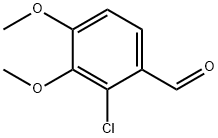
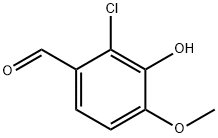
Step 2 - Formation of 2-chloro-3,4-dimethoxybenzaldehyde: To a 100 mL solution of 8.03 g (43 mmol) of 2-chloro-3-hydroxy-4-methoxybenzaldehyde in acetonitrile was added 7.7 g (55 mmol) of powdered potassium carbonate, followed by the addition of 8.3 mL (0.13 mol) of iodomethane. The reaction mixture was slowly heated to reflux and stirred continuously at this temperature for 24 hours. Upon completion of the reaction, it was cooled to room temperature, the suspension was filtered and the filtrate was evaporated under vacuum to remove the solvent to give 8.5 g (42 mmol, 98% yield) of white solid. The resulting solid was confirmed to be 2-chloro-3,4-dimethoxybenzaldehyde by 1H NMR analysis.