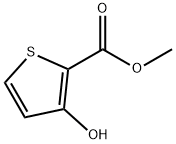
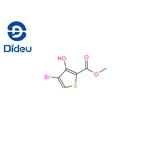
General procedure for the synthesis of methyl 4-bromo-3-hydroxythiophene-2-carboxylate from methyl 3-hydroxy-2-thiophenecarboxylate: 3.24 mL (63.2 mmol) of bromine was slowly added to a solution of 10 g (63.2 mmol) of methyl 3-hydroxy-2-thiophenecarboxylate in 22 mL of acetic acid and the reaction mixture was stirred at room temperature for 24 hours. Upon completion of the reaction, the reaction solution was poured into 50 mL of water and extracted with 50 mL of dichloromethane. The organic phases were combined, washed twice with 50 mL of water and dried over anhydrous magnesium sulfate. The solvent was removed by concentration under reduced pressure to give the crude product. The crude product was purified by rapid chromatography on silica gel (eluent: dichloromethane/petroleum ether, 1:2) to give 11.3 g methyl 4-bromo-3-hydroxythiophene-2-carboxylate in 76% yield. The melting point of the product was 86 °C. 1H NMR (CDCl3): δ 3.92 (s, 3H), 7.38 (s, 1H), 9.74 (s, 1H). 13C NMR (CDCl3): δ 52.2, 102.6, 103.8, 128.1, 160.4, 165.8. MS (EI): m/z = 236 (M+.). .
[1] Tetrahedron Letters, 2009, vol. 50, # 35, p. 5005 - 5008
[2] Tetrahedron Letters, 2011, vol. 52, # 12, p. 1288 - 1291
[3] Synthesis, 1984, vol. NO. 10, p. 847 - 850
[4] Tetrahedron Letters, 2017, vol. 58, # 26, p. 2537 - 2541
[5] Patent: US4748183, 1988, A