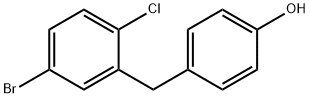
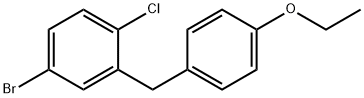
Example 1 Synthesis of 4-(5-bromo-2-chlorobenzyl)phenol: To a stirred dichloromethane solution (250 mL) of 4-bromo-1-chloro-2-(4-ethoxybenzyl)benzene (8.47 g, 0.026 mol) was added slowly and dropwise to a dichloromethane solution (8 mL, 4M) of tribromoborane at -78 °C. The reaction mixture was continued to be stirred at -78°C for 30 minutes, then brought to room temperature and stirred for 1 hour. Upon completion of the reaction, the reaction was quenched by slow addition of saturated aqueous sodium bicarbonate solution (200 mL) and the mixture was extracted three times with ethyl acetate. The organic phases were combined, washed once with saturated aqueous sodium chloride solution and dried over anhydrous sodium sulfate. The solvent was removed by concentration under reduced pressure and the residue was purified by silica gel column chromatography (eluent: petroleum ether/ethyl acetate, 10:1) to afford the target product 4-(5-bromo-2-chlorobenzyl)phenol. Yield: 6.85 g, 89%. LC-MS (ESI): m/z = 297/299 (Cl)[M + H]+.
[1] Patent: WO2015/43511, 2015, A1. Location in patent: Paragraph 00201
[2] Patent: WO2011/51864, 2011, A1. Location in patent: Page/Page column 27-28
[3] Patent: CN108218928, 2018, A. Location in patent: Paragraph 0217; 0218; 0219
[4] Bioorganic and Medicinal Chemistry Letters, 2011, vol. 21, # 15, p. 4465 - 4470
[5] Patent: WO2009/26537, 2009, A1. Location in patent: Page/Page column 41