Dimethirimol is a systemic, eradicant fungicide. It has a high aqueous solubility and is quite volatile. Based on its chemical properties, it may leach to groundwater. It can be persistent in soil systems. Dimethirimol has a low mammalian toxicity. It is moderately toxic to birds and fish.
Pure product is white needle crystal, odorless. m.p.102℃, vapor pressure 1.46×10⁻³Pa (30℃), solubility at 25℃: chloroform 1200g/L, xylene 360g/L, ethanol 65g/L, propanol 45g/L, water 1.2g/L. Stable to acid, alkali, and heat, and non-corrosive to metal.
Dimethrimolis a fungicide used initially to prevent powdery mildew and other fungal infections or crops. Pesticide.
Dimethirimol is a systemic fungicide that provides both protective
and curative control of powdery mildew (Sphaeratheca fulginea)
in cucurbits. Other uses include tobacco, tomatoes and ornamentals.
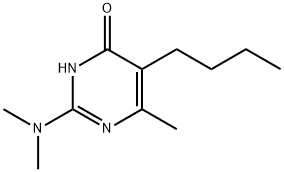
ChEBI: A member of the class of aminopyrimidines that is 2-dimethylaminopyrimidine carrying methyl, butyl and hydroxy substituents at posiitons 4, 5 and 6 respectively. A fungicide first marketed in 1970, and used particularly in glasshouses to control powdery mi
dew, it is no longer approved for use within the European Union.
The commercial production of dimethirimol involves a multi-step process. It starts with the condensation of ethyl acetoacetate and butylamine to form an intermediate, followed by cyclisation with guanidine or a dimethylguanidine derivative in the presence of a base, such as sodium ethoxide, in an alcoholic solvent under controlled temperature to yield the pyrimidine ring structure. The crude dimethirimol is purified through filtration, washing, and recrystallisation to achieve high purity.
Systemic, ergosterol biosynthesis inhibitor. Nucleic acid synthesis - adenosin-deaminase.
Information presented in this summary is abstracted from unpublished
data in the 1971 ICI dimethirimol petition submitted to the Canadian
authority. Dimethirimol is rapidly metabolised in both plants and
animals. Primary metabolic reactions in soils, plants and animals are
N-dealkylation, hydroxylation of the butyl group and the direct conjugation
of dimethirimol in plants (glucosides) and animals (glucuronides).
Metabolic pathways are shown in Scheme 1.
Dimethirimol (1) is stable to heat and in acid and alkahe solutions. It is
decomposed rather rapidly in aqueous solution when exposed to sunlight
with an observed DT50 of 7 days.