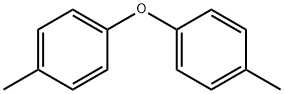
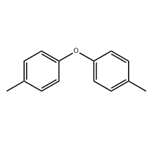
In a 10 mL sealed tube, p-cresol (1.2 mmol), cuprous iodide (0.05 mmol), ligand L-II-34 (0.1 mmol), and potassium phosphate (2.0 mmol) were added. The tube was purged with argon three times under vacuum. Then, p-methylchlorobenzene (1.0 mmol) and 1 mL DMSO were added. The reaction was stirred uniformly at 120 °C for 24 hours. After cooling, the contents of the sealed tube were washed with ethyl acetate and filtered through a silica gel and diatomaceous earth column. The filtrate was concentrated and then subjected to column chromatography to obtain the product 4-Tolyl ether.
Di-p-tolyl ether is a white or colorless flaky or leafy crystals. Almost insoluble in water, soluble in alcohol, miscible with most perfume oils.
Mild, green-rosy, somewhat woody odor
of great tenacity.
Di-p-tolyl ether is used to form conformationally chiral molecules in the solid state, while the chirality of 1,3-dimethyl-2-phenoxybenzene arises from the formation of supramolecular helices.
Suggested for use in soap and detergent
perfumes, partly as a fixative, partly as a
background note in Rose, Geranium, Lavender, New Mown Hay, Fougère and many
other perfume types. It is sufficiently mild.
not harsh, that it can be utilized in a great
variety of fragrance types.