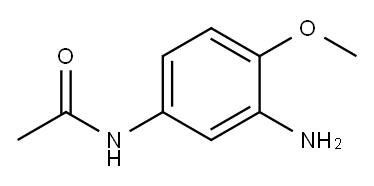
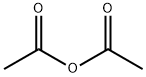
In conjunction with the accompanying drawings, a continuous flow reactor equipped with a solid-liquid separator was connected to a constant-flow pressure pump and a nitrogen cylinder, respectively. First, nitrogen was introduced to displace the air in the reaction system, followed by heating the first part of the reactor to the set temperature using an oil bath and adjusting the pressure of the first reactor to the desired value by means of a back pressure valve. A methanol solution of 2,4-dinitroanisole with catalyst (1% Pd/C, particle size <100 μm) was introduced from inlet 1 via a metering pump, preheated and fed into the tubular continuous flow reactor. At the same time, hydrogen was introduced from inlet 2 via a gas flow meter into the same reactor. After reacting at a specific temperature and pressure for a certain period of time, the mixture enters a gas-liquid-solid separator, where the catalyst is separated and recycled, while the liquid phase is introduced directly into the second reactor through inlet 3. In the second reactor, acid and acetic anhydride are added from feed ports 4 and 5, respectively, via a metering pump, and mixed with hydrogen and reacted at a set temperature. Upon completion of the reaction, the mixture entered the post-treatment tank, and was subjected to filtration, distillation to recover methanol, washing and recrystallization steps to finally obtain 3-amino-4-methoxyacetanilide. The process has a maximum yield of 99% and a product purity of 99.9% (see Example 11).