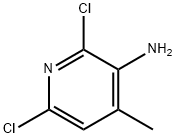
Skin contact of 2,6-Dichloro-4-methyl-3-aminopyridine may result in inflammation characterized by itching, scaling, reddening, blistering, pain or dryness. Eye contact may result in redness, pain or severe eye damage. Inhalation may cause irritation of the lungs and respiratory system. Overexposure may result in serious illness or death.
[1] Journal of Heterocyclic Chemistry, 1995, vol. 32, # 1, p. 259 - 263
[2] Journal of Medicinal Chemistry, 1995, vol. 38, # 24, p. 4830 - 4838
[3] Patent: US5200522, 1993, A
[4] Patent: US5571912, 1996, A