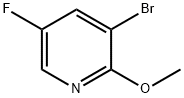
2-Methoxy-3-bromo-5-fluoropyridine is liquid at room temperature and pressure, with a density of 1.6 g/cm3 and a boiling point of 188.4±35.0 °C (760 mmH) at one atmospheric pressure. In organic synthetic transformations, bromine atoms on the pyridine ring can be reacted with an arylboron reagent to join two aryl groups at the 3 position in the presence of a couple, and furthermore the bromine atoms on the pyridine ring can also be converted to boron units by reacting with triisopropyl borate in the presence of n-butyllithium. In addition, the bromine atom on the pyridine ring can be converted to a boron unit by reacting with triisopropyl borate in the presence of n-butyllithium. In addition, due to the electron-deficient nature of the pyridine ring, the bromine atom on the pyridine ring can be attacked by a nucleophilic reagent to obtain a debromofunctionalized product.
General steps:
1. Prepare raw material: (R)-5-fluoro-2-methoxy-3-(pyrrolidin-2-yl)pyridine.
2. Step A: Synthesis of 3-bromo-5-fluoro-2-methoxypyridine.
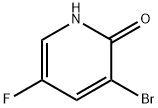
a. Add 3-bromo-5-fluoropyridin-2(1H)-one (10.0 g, 52.1 mmol) and Ag2CO3 (10.0 g, 36.5 mmol) to toluene (100 mL).
b. Slowly add iodomethane (3.89 mL, 62.5 mmol).
c. The reaction mixture was stirred at room temperature overnight.
d. Upon completion of the reaction, filter through diatomaceous earth and wash the solids with toluene.
e. The filtrate was concentrated to give the crude product.
f. The crude product was purified by silica gel column chromatography (eluent: 5-25% EtOAc/hexane) to afford 3-bromo-5-fluoro-2-methoxypyridine (4.70 g, 43.8% yield) as a colorless oil.