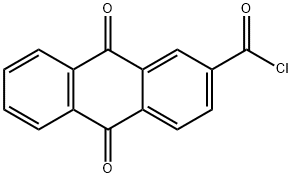
Anthraquinone-2-formyl chloride can be used as a pharmaceutical synthesis intermediate, as shown in the following reaction: Phenylalanine methyl ester is added to a reaction flask, dissolved in dichloromethane. Triethylamine (3 g, 30 mmol) is added, and a solution of 9,10-anthraquinone-2-formyl chloride in dichloromethane is added dropwise while stirring below 0°C. After the addition is complete, the mixture is stirred for several minutes, then moved to room temperature and stirred overnight. Part of the solvent is evaporated by rotary evaporation, and crystals are precipitated by standing. The crude product is washed with water and recrystallized from acetonitrile to obtain the pure product. Alternatively, N-9,10-anthraquinone-2-formylphenylalanine methyl ester (0.34 g, 10 mmol), 5 mL of 4% NaOH solution, 1 mL of methanol, and 1 mL of tetrahydrofuran are added to a reaction flask. The mixture is stirred at 50°C for 4 hours, diluted with water, and the pH is adjusted to 3 with dilute sulfuric acid. Flocculent material precipitates, and the product is obtained by filtration and washing with water. 1H-NMR (300MHz, DMSO-d6): 12.85 (s, 1H, COOH), 9.26 (s, 1H, NH), 8.62 (s, 1H, Ar-H), 8.23 (m, 4H, Ar-H), 7.95 (m, 2H, Ar-H), 7.25 (m, 5H, Ph-H), 4.69 (t, 1H, J=2.4Hz, CH), 3.22 (m, 2H, CH2).